 Seneca
 Marcus Aurelius
A question from your life
A decision, a burst of anger, a wish to change: bring what is on your mind.

Practice philosophy. Question 2,500 years of thought.

Enter with a real question. Historically constrained voices, inspectable sources, and connected ideas turn Prokopton42 from a library into a place of practice.
A decision, a burst of anger, a wish to change: bring what is on your mind.
Philosophy, religion, fiction: see how their answers sit with your beliefs.
Follow the conversation back to the books that give it substance.
The Living Stoa. A symbolic scene: these figures did not literally meet.
Especially when we need to decide how to live.
An argument you keep replaying. A decision you put off. The feeling that you never have time for what matters. These are the questions you can bring to Prokopton42.
Here, AI gives thinkers a voice drawn from their texts. You describe your situation, ask them questions and answer back.
The project grew from a wish to practise philosophy in the middle of life: in our relationships, our work and the way we act.
Seneca was a Stoic who readily quoted Epicurus. You can learn from someone without joining their school. That freedom is where we start.
We want to bring 2,500 years of thought, belief and human experience into conversation with yours.
You have something to say to them, too.
You need no background in philosophy to begin.
An idea becomes useful when you try it: in a decision, a habit or your next difficult conversation.
Citations open the texts that inform the dialogue. Read the passage in full and make up your own mind.
Explore another school, another era, another belief. Give an unfamiliar thought a chance to surprise you.
Create a conversation space, invite one or more thinkers and write as you would speak. For example:
“I know this argument is going nowhere. Why do I still want the last word?”
Ask a follow-up, challenge an answer, explain what you find difficult. Then choose something to try in your day. That is where practice begins.
First, you would have to explain what a phone is.
Your everyday world is not his. That distance can make the conversation interesting: something you take for granted may need explaining.
You can introduce your world yourself or enable Quantum Leap. A temporal guide then joins briefly to explain the modern context in a visible intervention.
Then ask about your attention, your time, or why you feel you should always be available.
The tools have changed. What do we want to spend our days on?
Among the thinkers you can explore, Seneca and Marcus Aurelius offer two familiar ways in: letters to a friend and notes written for oneself.
Choose the one whose questions speak to yours.
Time, friends, money and a temper that gets away from you.
Seneca writes to Lucilius about the concerns that fill a life. Ask him about the ambition that wears you out, or everything you keep putting off.
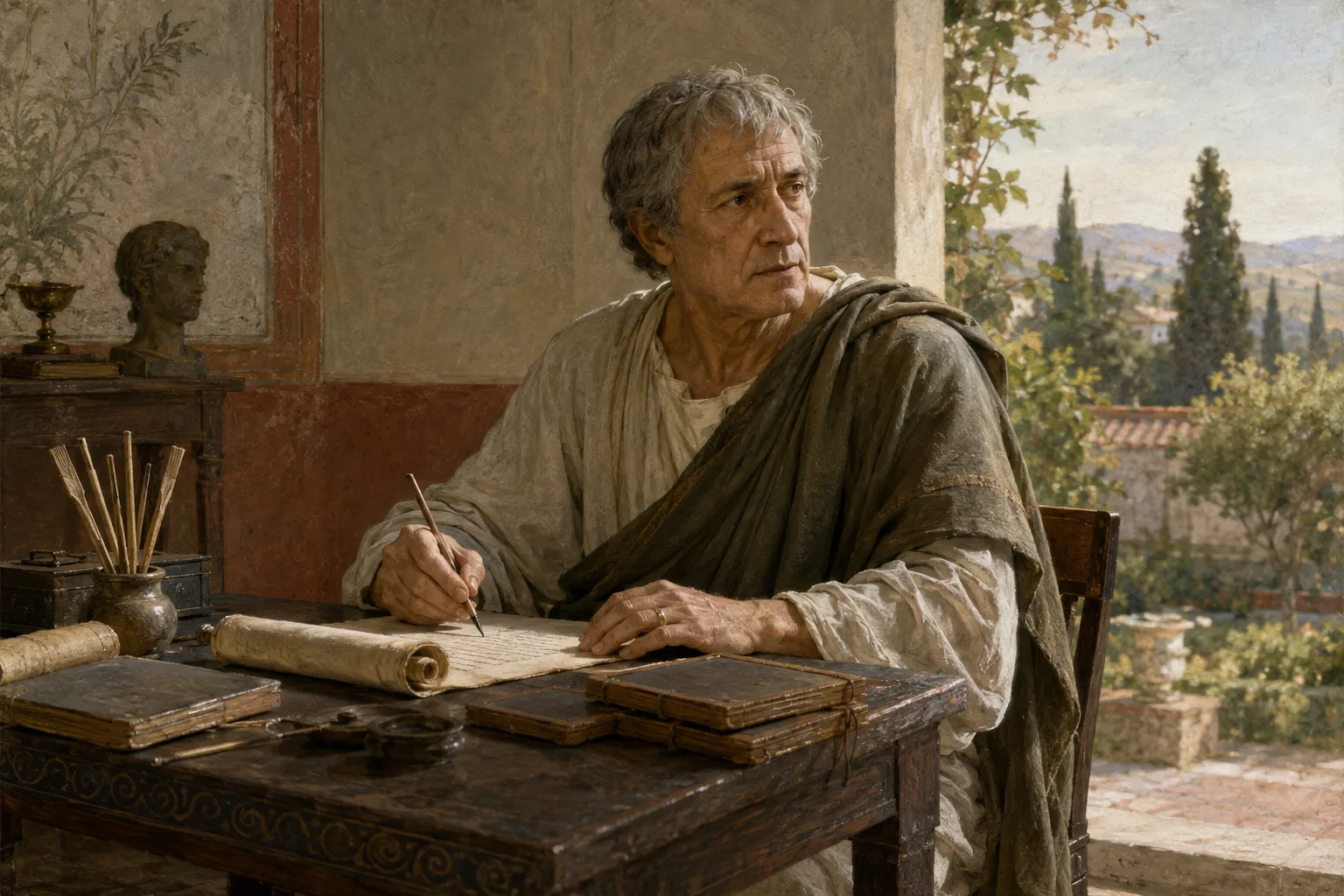
How to act when the day tests your patience.
In his Meditations, Marcus Aurelius reminds himself how to deal with other people, his duties and his own impatience. Bring him a responsibility you find hard to carry.

Socrates, Epicurus, Laozi, the Buddha, Jesus, Spinoza… and even Yoda. The catalogue brings together philosophers, religious traditions and fictional characters.
Each profile explains whom you are meeting, which texts inform their voice and whether dialogue is available.
A question about desire might take you from Epicurus to the Buddha. A fear might find an echo in a Stoic or in Yoda. Stories shape how we live, too.
Invite several voices into one conversation. Explore where they agree, where they clash and what you take from the exchange. Borrow an idea, reject another and work out your own way forward.
Click a citation to read the passage it comes from. Browse the library, compare translations and follow connections between ideas. An old text reads differently when it speaks to a question you are living with.
AI recreates the voices. The texts are there to read, the interpretations open to debate.
With a nod to anyone who already has the answer to everything.
Prokopton is Greek for someone making progress. The 42 comes from Douglas Adams’s The Hitchhiker’s Guide to the Galaxy: the answer to the ultimate question of life, the universe and everything. The question itself remains a problem.
We like that meeting of serious practice and the humour that stops us mistaking ourselves for sages.
Progress here might begin with admitting you were wrong, or letting someone finish speaking.
A decision to make, a belief to examine, a situation you would like to handle differently.
Choose whom to invite. Tell them what brought you here.
You are part of what happens next.