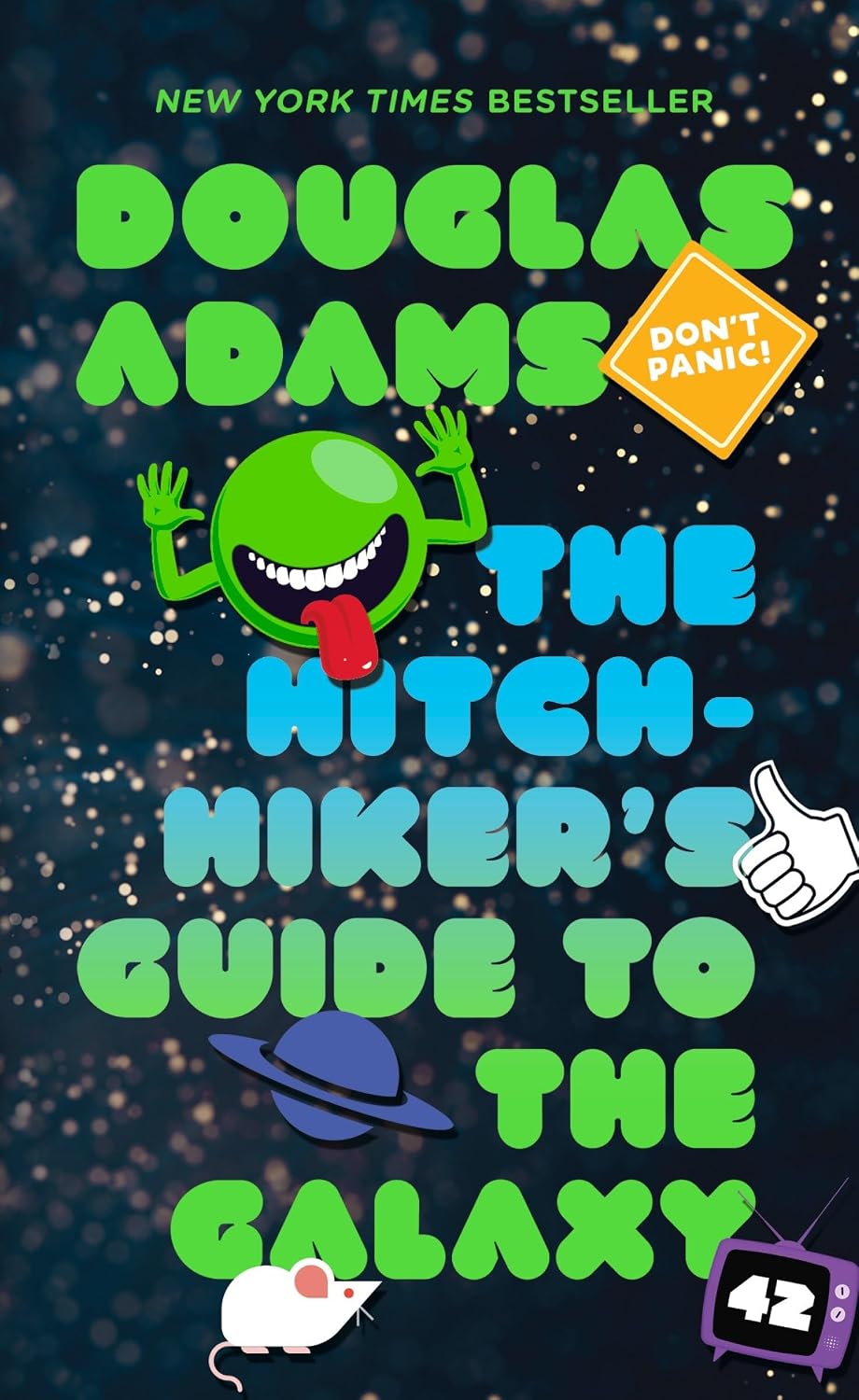
Cover of another edition
The Hitchhiker’s Guide to the Galaxy, by Douglas Adams
About this workSummary, languages, provenance, and download
What you will learnThe main threads to follow while reading
Track how the answer 42 becomes comic when its question remains unknown, then follow the shifts of perspective imposed on Arthur Dent.
In a few words (short summary)The book’s argument, structure, and limits
Arthur Dent leaves a doomed Earth and discovers a Guide in which absurdity is a survival method. The first novel introduces the answer 42.
The first novel follows Arthur Dent after the Vogons destroy Earth. Ford Prefect, a researcher for the Guide, draws him into a journey where space bureaucracy, chance, and metaphysical questions collide. The answer 42 appears here without revealing the question that would make it meaningful.
This record covers the first novel extracted from the HTML anthology. It does not stand for the four sequels or the short story in the same source file.
Four-page AI synthesisA complete reading to browse without leaving the page
A house marked for demolition
The story opens by shrinking Earth to an almost negligible spot in the Galaxy. Its inhabitants are unhappy much of the time and keep proposing solutions involving money, although money is not what is suffering. One woman finally sees how the world might be made happy, but a catastrophe prevents her from telling anyone. The novel follows that catastrophe and some of its consequences. It also follows the Hitchhiker’s Guide to the Galaxy, a celebrated book with gaps and unreliable entries. It is cheaper than its more solemn rival and carries one immediately usable instruction on its cover: don’t panic.
The first demolition is small enough to have a bulldozer parked outside Arthur Dent’s house. A bypass is about to replace his home, and Arthur lies in the mud to stop the work. The council says the plans have been available for nine months. He found them in a locked filing cabinet inside a disused lavatory. The procedure has technically been followed, while the person most affected has had no meaningful chance to respond. Mr Prosser can offer no better reason for building the bypass than the fact that bypasses are the sort of thing one builds.
Ford Prefect arrives to collect Arthur. Arthur thinks his friend comes from Guildford; Ford is actually a travelling researcher for the Guide, stranded on Earth for fifteen years after arriving from a planet near Betelgeuse. Ford persuades Mr Prosser to take Arthur’s place in front of the bulldozer and takes Arthur to the pub. He knows that ships are approaching and urges Arthur to drink. While Arthur discovers that his house has been knocked down after all, the Vogons announce a second project: Earth must be removed for a hyperspace express route.
The notice for that demolition, they say, has long been displayed in a planning office on Alpha Centauri. Their excuse repeats the council’s logic on a scale at which no human protest can stop the work. Earth is destroyed. Ford and Arthur survive by transferring aboard a Vogon ship, helped by the Dentrassis who work there as cooks. Arthur has lost both his house and his planet in a single day. The change in scale is funny, but it does not make the loss unreal to him.
Survival by guidebook and improbability
Aboard the Vogon ship, Ford gives Arthur food to help him recover from the transfer and shows him the electronic Guide. Its entry for Earth originally consists of one word, “Harmless”. Ford has managed to improve it to “Mostly harmless”, a painfully small tribute to the world Arthur has just lost. Ford also puts a Babel fish in Arthur’s ear so he can understand alien speech. The Guide offers a biological account of its translation, a joke about proving God’s nonexistence, and a darker observation: removing language barriers has not prevented wars between cultures.
The Vogon captain discovers the stowaways. Before expelling them, he makes them hear his poetry through equipment designed to intensify every detail. Arthur tries to save them by praising the poem, and Ford joins in with improvised literary commentary. It fails. As a guard drags them toward the airlock, Ford asks whether shouting at people and throwing them out of ships makes for a satisfying life. The guard admits that most of his working minutes are poor, yet promotion depends on continuing to shout and push. He carries out the order and ejects them into space.
The Guide says they can survive about thirty seconds in a vacuum, while judging rescue within that time fantastically unlikely. A ship picks them up after twenty-nine seconds. Its drive briefly makes their surroundings behave in impossible ways before ordinary probability returns. This is the Heart of Gold, powered by the newly developed Infinite Improbability Drive. Zaphod Beeblebrox, a Galactic President whose office mainly diverts attention from power elsewhere, stole the prototype at its unveiling. Trillian looks after the ship, and Marvin, a brilliant, miserable robot, brings the survivors to its bridge.
The meeting gathers several histories into one improbable room. Ford knows Zaphod as his semi-cousin. Arthur recognizes him as the man who, calling himself Phil, once interrupted Arthur’s conversation with a woman at a party on Earth. That woman is Trillian, who accepted Zaphod’s offer of a lift away from the planet. Their reunion is startling even to people travelling by improbable means. The ship itself picked Ford and Arthur up during its flight. Zaphod is nevertheless pursuing a destination of his own: Magrathea, a legendary planet hidden in the Horsehead Nebula.
Magrathea changes the story of Earth
Magrathea once built planets to order. Its wealthy customers could buy a world shaped around their preferences, down to the colour of its seas or the length of its days. Ford initially doubts that such a business ever existed. Zaphod insists that he has found its home, though he cannot clearly explain what he is seeking there. From orbit the planet looks dead, but an old automatic system warns the ship away and fires two missiles. Nobody aboard can manage the manual controls. Arthur switches on the Improbability Drive without programming it, turning the missiles into a bowl of petunias and a sperm whale.
The ship lands. The whale, brought into existence only moments before, has fallen to the surface and opened a passage into the planet. Zaphod leads Ford and Trillian below ground while Arthur remains outside with Marvin. In the passages, Zaphod admits to Ford that he does not fully understand his own decisions. He became president, stole the ship and sought Magrathea, yet suspects that an inaccessible part of his mind has been steering him. A steel shutter and a release of gas interrupt the conversation. At this stage, the precise reason for his search remains unexplained.
Arthur meets Slartibartfast, an elderly Magrathean, on the surface. He says his people slept for five million years after an economic collapse left no market for custom-built luxury planets. He takes Arthur into a vast factory housed in hyperspace and reveals that Earth was one of their products. Slartibartfast designed its Norwegian fjords and remembers them with pride. Earth’s clients, he says, were mice. The planet was destroyed five minutes before it completed the purpose for which they had commissioned it; work on a replacement Earth has already begun.
The explanation reverses several human assumptions. According to Slartibartfast, the mice seen in laboratories were only the visible presence of hyperintelligent beings from another dimension. Their behaviour in experiments was guiding the human researchers who thought they were studying them. The story has already revealed that dolphins knew Earth would be destroyed and tried to warn humanity, which mistook their messages for entertaining tricks. Arthur now learns that humans and their planet formed the matrix of an organic computer carrying out a ten-million-year research programme.
An answer without its question
Slartibartfast takes Arthur back to the programme’s origins. Two representatives of an earlier age activate Deep Thought, a computer built to answer the great question of life, the Universe and everything. It calls itself the second greatest computer there will be: a greater one is to follow it. Two philosophers immediately object. They fear that a definite answer will put them out of work and claim the right to keep debating uncertain truths. Deep Thought continues its calculation regardless. It announces that the result will take seven and a half million years.
Arthur then experiences a Magrathean recording of the day the programmers’ descendants receive the result. The ceremony and the long wait are out of proportion to the answer’s apparent simplicity. The supplied editorial notice identifies that answer as “42” and states that the question needed to make sense of it remains unknown. The number is comic because it formally answers a vast request while explaining nothing about what was really asked. Computational power cannot make an undefined question precise.
Earth thus has a particular place in the story. It was Arthur’s lost home, but it was also a device intended to carry a search beyond the first answer. That purpose offers him no consolation. Slartibartfast mourns a destroyed piece of workmanship, especially its coastlines; the clients have lost a programme interrupted just before completion; Arthur remembers a place where he lived. Their losses overlap without becoming the same loss. The novel repeatedly brings immense galactic explanations back to ordinary needs, habits and grief.
Its jokes work through that movement too. Demolition notices placed beyond the reach of those affected, a useful but unreliable Guide, a robot burdened with a personality he hates, and a ship saved by Arthur’s desperate guess all show systems that operate while failing the people who depend on them. The supplied source evidence stops as Deep Thought is about to give its answer. The editorial notice establishes the number 42, but the packet does not document the rest of that scene or the expedition’s ending on Magrathea. What it does establish is the tension between possessing an answer and losing the means to discover its question.
Synthesis generated by GPT-5.6 from the normalized text of the work. It is a reading aid, not a substitute for reading or citing the text.
- Availability
- Text available
- Text quality
- Automatic checks passed
- Text format
- Digital text extracted from the document
- Document type
- Author’s text
- Usage rights
- Authorized for this project
- Excerpts
- 176
The Hitchhiker’s Guide to the Galaxy, by Douglas Adams section 2
HTML section 2, excerpt 1/13
Chapter 1
The house stood on a slight rise just on the edge of the village. It stood on its own and looked over a broad spread of West Country farmland. Not a remarkable house by any means-it was about thirty years old, squattish, squarish, made of brick, and had four windows set in the front of a size and proportion which more or less exactly failed to please the eye.
The only person for whom the house was in any way special was Arthur Dent, and that was only because it happened to be the one he lived in. He had lived in it for about three years, ever since he had moved out of London because it made him nervous and irritable. He was about thirty as well, dark haired and never quite at ease with himself. The thing that used to worry him most was the fact that people always used to ask him what he was looking so worried about. He worked in local radio which he always used to tell his friends was a lot more interesting than they probably thought. It was, too-most of his friends worked in advertising.
It hadn't properly registered with Arthur that the council wanted to knock down his house and build an bypass instead.
At eight o'clock on Thursday morning Arthur didn't feel very good. He woke up blearily, got up, wandered blearily round his room, opened a window, saw a bulldozer, found his slippers, and stomped off to the bathroom to wash.
Toothpaste on the brush-so. Scrub.
Shaving mirror-pointing at the ceiling. He adjusted it. For a moment it reflected a second bulldozer through the bathroom window. Properly adjusted, it reflected Arthur Dent's bristles. He shaved them off, washed, dried, and stomped off to the kitchen to find something pleasant to put in his mouth.
Kettle, plug, fridge, milk, coffee. Yawn.
HTML section 2, excerpt 2/13
The wordbulldozer wandered through his mind for a moment in search of something to connect with.
The bulldozer outside the kitchen window was quite a big one.
He stared at it.
"Yellow," he thought and stomped off back to his bedroom to get dressed.
Passing the bathroom he stopped to drink a large glass of water, and another. He began to suspect that he was hung over. Why was he hung over? Had he been drinking the night before? He supposed that he must have been. He caught a glint in the shaving mirror. "Yellow," he thought and stomped on to the bedroom.
He stood and thought. The pub, he thought. Oh dear, the pub. He vaguely remembered being angry, angry about something that seemed important. He'd been telling people about it, telling people about it at great length, he rather suspected: his clearest visual recollection was of glazed looks on other people's faces. Something about a new bypass he had just found out about. It had been in the pipeline for months only no one seemed to have known about it. Ridiculous. He took a swig of water. It would sort itself out, he'd decided, no one wanted a bypass, the council didn't have a leg to stand on. It would sort itself out.
God what a terrible hangover it had earned him though. He looked at himself in the wardrobe mirror. He stuck out his tongue. "Yellow," he thought. The wordyellow wandered through his mind in search of something to connect with.
Fifteen seconds later he was out of the house and lying in front of a big yellow bulldozer that was advancing up his garden path.
HTML section 2, excerpt 3/13
Mr. L Prosser was, as they say, only human. In other words he was a carbon-based life form descended from an ape. More specifically he was forty, fat and shabby and worked for the local council. Curiously enough, though he didn't know it, he was also a direct male-line descendant of Genghis Khan, though intervening generations and racial mixing had so juggled his genes that he had no discernible Mongoloid characteristics, and the only vestiges left in Mr. L Prosser of his mighty ancestry were a pronounced stoutness about the tum and a predilection for little fur hats.
He was by no means a great warrior: in fact he was a nervous worried man. Today he was particularly nervous and worried because something had gone seriously wrong with his job-which was to see that Arthur Dent's house got cleared out of the way before the day was out.
"Come off it, Mr. Dent,", he said, "you can't win you know. You can't lie in front of the bulldozer indefinitely." He tried to make his eyes blaze fiercely but they just wouldn't do it.
Arthur lay in the mud and squelched at him.
"I'm game," he said, "we'll see who rusts first."
"I'm afraid you're going to have to accept it," said Mr. Prosser gripping his fur hat and rolling it round the top of his head, "this bypass has got to be built and it's going to be built!"
"First I've heard of it," said Arthur, "why's it going to be built?"
Mr. Prosser shook his finger at him for a bit, then stopped and put it away again.
"What do you mean, why's it got to be built?" he said. "It's a bypass. You've got to build bypasses."
HTML section 2, excerpt 4/13
Bypasses are devices which allow some people to drive from point A to point B very fast whilst other people dash from point B to point A very fast. People living at point C, being a point directly in between, are often given to wonder what's so great about point A that so many people of point B are so keen to get there, and what's so great about point B that so many people of point A are so keen to get there. They often wish that people would just once and for all work out where the hell they wanted to be.
Mr. Prosser wanted to be at point D. Point D wasn't anywhere in particular, it was just any convenient point a very long way from points A, B and C. He would have a nice little cottage at point D, with axes over the door, and spend a pleasant amount of time at point E, which would be the nearest pub to point D. His wife of course wanted climbing roses, but he wanted axes. He didn't know why-he just liked axes. He flushed hotly under the derisive grins of the bulldozer drivers.
He shifted his weight from foot to foot, but it was equally uncomfortable on each. Obviously somebody had been appallingly incompetent and he hoped to God it wasn't him.
Mr. Prosser said: "You were quite entitled to make any suggestions or protests at the appropriate time you know."
"Appropriate time?" hooted Arthur. "Appropriate time? The first I knew about it was when a workman arrived at my home yesterday. I asked him if he'd come to clean the windows and he said no he'd come to demolish the house. He didn't tell me straight away of course. Oh no. First he wiped a couple of windows and charged me a fiver. Then he told me."
"But Mr. Dent, the plans have been available in the local planning office for the last nine month."
HTML section 2, excerpt 5/13
"Oh yes, well as soon as I heard I went straight round to see them, yesterday afternoon. You hadn't exactly gone out of your way to call attention to them had you? I mean like actually telling anybody or anything."
"But the plans were on display..."
"On display? I eventually had to go down to the cellar to find them."
"That's the display department."
"With a torch."
"Ah, well the lights had probably gone."
"So had the stairs."
"But look, you found the notice didn't you?"
"Yes," said Arthur, "yes I did. It was on display in the bottom of a locked filing cabinet stuck in a disused lavatory with a sign on the door saying Beware of the Leopard."
A cloud passed overhead. It cast a shadow over Arthur Dent as he lay propped up on his elbow in the cold mud. It cast a shadow over Arthur Dent's house. Mr. Prosser frowned at it.
"It's not as if it's a particularly nice house," he said.
"I'm sorry, but I happen to like it."
"You'll like the bypass."
"Oh shut up," said Arthur Dent. "Shut up and go away, and take your bloody bypass with you. You haven't got a leg to stand on and you know it."
Mr. Prosser's mouth opened and closed a couple of times while his mind was for a moment filled with inexplicable but terribly attractive visions of Arthur Dent's house being consumed with fire and Arthur himself running screaming from the blazing ruin with at least three hefty spears protruding from his back. Mr. Prosser was often bothered with visions like these and they made him feel very nervous. He stuttered for a moment and then pulled himself together.
"Mr. Dent," he said.
"Hello? Yes?" said Arthur.
"Some factual information for you. Have you any idea how much damage that bulldozer would suffer if I just let it roll straight over you?"
"How much?" said Arthur.
HTML section 2, excerpt 6/13
"None at all," said Mr. Prosser, and stormed nervously off wondering why his brain was filled with a thousand hairy horsemen all shouting at him.
By a curious coincidence, None at all is exactly how much suspicion the ape-descendant Arthur Dent had that one of his closest friends was not descended from an ape, but was in fact from a small planet in the vicinity of Betelgeuse and not from Guildford as he usually claimed.
Arthur Dent had never, ever suspected this.
This friend of his had first arrived on the planet some fifteen Earth years previously, and he had worked hard to blend himself into Earth society-with, it must be said, some success. For instance he had spent those fifteen years pretending to be an out of work actor, which was plausible enough.
He had made one careless blunder though, because he had skimped a bit on his preparatory research. The information he had gathered had led him to choose the name "Ford Prefect" as being nicely inconspicuous.
He was not conspicuously tall, his features were striking but not conspicuously handsome. His hair was wiry and gingerish and brushed backwards from the temples. His skin seemed to be pulled backwards from the nose. There was something very slightly odd about him, but it was difficult to say what it was. Perhaps it was that his eyes didn't blink often enough and when you talked to him for any length of time your eyes began involuntarily to water on his behalf. Perhaps it was that he smiled slightly too broadly and gave people the unnerving impression that he was about to go for their neck.
HTML section 2, excerpt 7/13
He struck most of the friends he had made on Earth as an eccentric, but a harmless one-an unruly boozer with some oddish habits. For instance he would often gatecrash university parties, get badly drunk and start making fun of any astrophysicist he could find till he got thrown out.
Sometimes he would get seized with oddly distracted moods and stare into the sky as if hypnotized until someone asked him what he was doing. Then he would start guiltily for a moment, relax and grin.
"Oh, just looking for flying saucers," he would joke and everyone would laugh and ask him what sort of flying saucers he was looking for.
"Green ones!" he would reply with a wicked grin, laugh wildly for a moment and then suddenly lunge for the nearest bar and buy an enormous round of drinks.
Evenings like this usually ended badly. Ford would get out of his skull on whisky, huddle into a corner with some girl and explain to her in slurred phrases that honestly the colour of the flying saucers didn't matter that much really.
Thereafter, staggering semi-paralytic down the night streets he would often ask passing policemen if they knew the way to Betelgeuse. The policemen would usually say something like, "Don't you think it's about time you went off home sir?"
"I'm trying to baby, I'm trying to," is what Ford invariably replied on these occasions.
In fact what he was really looking out for when he stared distractedly into the night sky was any kind of flying saucer at all. The reason he said green was that green was the traditional space livery of the Betelgeuse trading scouts.
Ford Prefect was desperate that any flying saucer at all would arrive soon because fifteen years was a long time to get stranded anywhere, particularly somewhere as mindboggingly dull as the Earth.
HTML section 2, excerpt 8/13
Ford wished that a flying saucer would arrive soon because he knew how to flag flying saucers down and get lifts from them. He knew how to see the Marvels of the Universe for less than thirty Altairan dollars a day.
In fact, Ford Prefect was a roving researcher for that wholly remarkable bookThe Hitchhiker's Guide to the Galaxy .
Human beings are great adaptors, and by lunchtime life in the environs of Arthur's house had settled into a steady routine. It was Arthur's accepted role to lie squelching in the mud making occasional demands to see his lawyer, his mother or a good book; it was Mr. Prosser's accepted role to tackle Arthur with the occasional new ploy such as the For the Public Good talk, the March of Progress talk, the They Knocked My House Down Once You Know, Never Looked Back talk and various other cajoleries and threats; and it was the bulldozer drivers' accepted role to sit around drinking coffee and experimenting with union regulations to see how they could turn the situation to their financial advantage.
The Earth moved slowly in its diurnal course.
The sun was beginning to dry out the mud Arthur lay in.
A shadow moved across him again.
"Hello Arthur," said the shadow.
Arthur looked up and squinting into the sun was startled to see Ford Prefect standing above him.
"Ford! Hello, how are you?"
"Fine," said Ford, "look, are you busy?"
"Am Ibusy ?" exclaimed Arthur. "Well, I've just got all these bulldozers and things to lie in front of because they'll knock my house down if I don't, but other than that... well, no not especially, why?"
They don't have sarcasm on Betelgeuse, and Ford Prefect often failed to notice it unless he was concentrating. He said, "Good, is there anywhere we can talk?"
"What?" said Arthur Dent.
HTML section 2, excerpt 9/13
For a few seconds Ford seemed to ignore him, and stared fixedly into the sky like a rabbit trying to get run over by a car. Then suddenly he squatted down beside Arthur.
"We've got to talk," he said urgently.
"Fine," said Arthur, "talk."
"And drink," said Ford. "It's vitally important that we talk and drink. Now. We'll go to the pub in the village."
He looked into the sky again, nervous, expectant.
"Look, don't you understand?" shouted Arthur. He pointed at Prosser. "That man wants to knock my house down!"
Ford glanced at him, puzzled.
"Well he can do it while you're away can't he?" he asked.
"But I don't want him to!"
"Ah."
"Look, what's the matter with you Ford?" said Arthur.
"Nothing. Nothing's the matter. Listen to me-I've got to tell you the most important thing you've ever heard. I've got to tell you now, and I've got to tell you in the saloon bar of the Horse and Groom."
"But why?"
"Because you are going to need a very stiff drink."
Ford stared at Arthur, and Arthur was astonished to find that his will was beginning to weaken. He didn't realize that this was because of an old drinking game that Ford learned to play in the hyperspace ports that served the madranite mining belts in the star system of Orion Beta.
The game was not unlike the Earth game called Indian Wrestling, and was played like this:
Two contestants would sit either side of a table, with a glass in front of each of them.
Between them would be placed a bottle of Janx Spirit (as immortalized in that ancient Orion mining song "Oh don't give me none more of that Old Janx Spirit/ No, don't you give me none more of that Old Janx Spirit/ For my head will fly, my tongue will lie, my eyes will fry and I may die/ Won't you pour me one more of that sinful Old Janx Spirit").
HTML section 2, excerpt 10/13
Each of the two contestants would then concentrate their will on the bottle and attempt to tip it and pour spirit into the glass of his opponent-who would then have to drink it.
The bottle would then be refilled. The game would be played again. And again.
Once you started to lose you would probably keep losing, because one of the effects of Janx spirit is to depress telepsychic power.
As soon as a predetermined quantity had been consumed, the final loser would have to perform a forfeit, which was usually obscenely biological.
Ford Prefect usually played to lose.
Ford stared at Arthur, who began to think that perhaps he did want to go to the Horse and Groom after all.
"But what about my house...?" he asked plaintively.
Ford looked across to Mr. Prosser, and suddenly a wicked thought struck him.
"He wants to knock your house down?"
"Yes, he wants to build..."
"And he can't because you're lying in front of the bulldozers?"
"Yes, and..."
"I'm sure we can come to some arrangement," said Ford. "Excuse me!" he shouted.
Mr. Prosser (who was arguing with a spokesman for the bulldozer drivers about whether or not Arthur Dent constituted a mental health hazard, and how much they should get paid if he did) looked around. He was surprised and slightly alarmed to find that Arthur had company.
"Yes? Hello?" he called. "Has Mr. Dent come to his senses yet?"
"Can we for the moment," called Ford, "assume that he hasn't?"
"Well?" sighed Mr. Prosser.
"And can we also assume," said Ford, "that he's going to be staying here all day?"
"So?"
"So all your men are going to be standing around all day doing nothing?"
"Could be, could be..."
"Well, if you're resigned to doing that anyway, you don't actually need him to lie here all the time do you?"
"What?"
HTML section 2, excerpt 11/13
"You don't," said Ford patiently, "actually need him here."
Mr. Prosser thought about this.
"Well no, not as such...", he said, "not exactly need..." Prosser was worried. He thought that one of them wasn't making a lot of sense.
Ford said, "So if you would just like to take it as read that he's actually here, then he and I could slip off down to the pub for half an hour. How does that sound?"
Mr. Prosser thought it sounded perfectly potty.
"That sounds perfectly reasonable," he said in a reassuring tone of voice, wondering who he was trying to reassure.
"And if you want to pop off for a quick one yourself later on," said Ford, "we can always cover up for you in return."
"Thank you very much," said Mr. Prosser who no longer knew how to play this at all, "thank you very much, yes, that's very kind..." He frowned, then smiled, then tried to do both at once, failed, grasped hold of his fur hat and rolled it fitfully round the top of his head. He could only assume that he had just won.
"So," continued Ford Prefect, "if you would just like to come over here and lie down..."
"What?" said Mr. Prosser.
"Ah, I'm sorry," said Ford, "perhaps I hadn't made myself fully clear. Somebody's got to lie in front of the bulldozers haven't they? Or there won't be anything to stop them driving into Mr. Dent's house will there?"
"What?" said Mr. Prosser again.
"It's very simple," said Ford, "my client, Mr. Dent, says that he will stop lying here in the mud on the sole condition that you come and take over from him."
"What are you talking about?" said Arthur, but Ford nudged him with his shoe to be quiet.
"You want me," said Mr. Prosser, spelling out this new thought to himself, "to come and lie there..."
"Yes."
"In front of the bulldozer?"
"Yes."
"Instead of Mr. Dent."
HTML section 2, excerpt 12/13
"Yes."
"In the mud."
"In, as you say it, the mud."
As soon as Mr. Prosser realized that he was substantially the loser after all, it was as if a weight lifted itself off his shoulders: this was more like the world as he knew it. He sighed.
"In return for which you will take Mr. Dent with you down to the pub?"
"That's it," said Ford. "That's it exactly."
Mr. Prosser took a few nervous steps forward and stopped.
"Promise?"
"Promise," said Ford. He turned to Arthur.
"Come on," he said to him, "get up and let the man lie down."
Arthur stood up, feeling as if he was in a dream.
Ford beckoned to Prosser who sadly, awkwardly, sat down in the mud. He felt that his whole life was some kind of dream and he sometimes wondered whose it was and whether they were enjoying it. The mud folded itself round his bottom and his arms and oozed into his shoes.
Ford looked at him severely.
"And no sneaky knocking down Mr. Dent's house whilst he's away, alright?" he said.
"The mere thought," growled Mr. Prosser, "hadn't even begun to speculate," he continued, settling himself back, "about the merest possibility of crossing my mind."
HTML section 2, excerpt 13/13
He saw the bulldozer driver's union representative approaching and let his head sink back and closed his eyes. He was trying to marshal his arguments for proving that he did not now constitute a mental health hazard himself. He was far from certain about this-his mind seemed to be full of noise, horses, smoke, and the stench of blood. This always happened when he felt miserable and put upon, and he had never been able to explain it to himself. In a high dimension of which we know nothing the mighty Khan bellowed with rage, but Mr. Prosser only trembled slightly and whimpered. He began to fell little pricks of water behind the eyelids. Bureaucratic cock-ups, angry men lying in the mud, indecipherable strangers handing out inexplicable humiliations and an unidentified army of horsemen laughing at him in his head-what a day.
What a day. Ford Prefect knew that it didn't matter a pair of dingo's kidneys whether Arthur's house got knocked down or not now.
Arthur remained very worried.
"But can we trust him?" he said.
"Myself I'd trust him to the end of the Earth," said Ford.
"Oh yes," said Arthur, "and how far's that?"
"About twelve minutes away," said Ford, "come on, I need a drink."