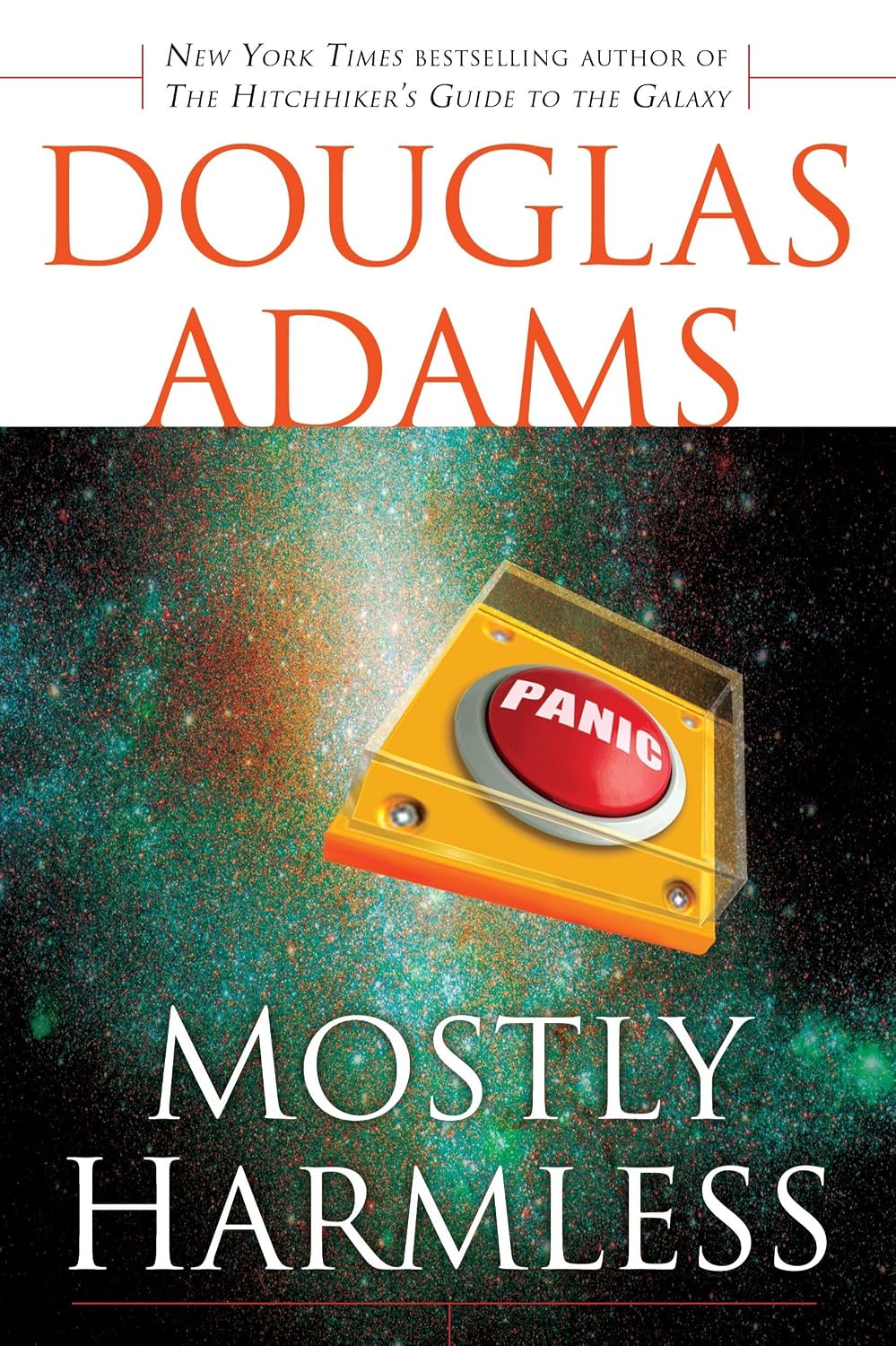
Cover of another edition
Mostly Harmless, by Douglas Adams
About this workSummary, languages, provenance, and download
What you will learnThe main threads to follow while reading
Compare competing versions of events and track what the characters can still treat as certain.
In a few words (short summary)The book’s argument, structure, and limits
The fifth novel returns to Arthur Dent, Ford Prefect, and those around them in a universe of competing versions.
The final novel shifts Arthur Dent’s and Ford Prefect’s bearings again. Divergent realities, decisions made by the Guide’s publisher, and family ties make any simple account of Earth and its disappearance harder to sustain.
This record contains the anthology’s fifth novel. The author biography and final notes in the file remain outside the narrative text.
Four-page AI synthesisA complete reading to browse without leaving the page
1. A story whose ground will not stay still
The novel opens by making orderly history look unreliable. Time travel has left galactic historians unable to sort causes from consequences, while the many possible states of Earth make even the idea of home uncertain. A tiny event may lead somewhere immense. This opening frames the separate paths of Arthur Dent, Ford Prefect, and two versions of Trillian. Their problems are personal, but they unfold in a universe where the identity of a planet or a person no longer guarantees a single, stable account of what happened.
A Grebulon reconnaissance ship supplies the first sustained example. A meteorite damages its memory and destroys the equipment that would have detected the damage. Robots sent to fetch a backup mission module fall through the hole, taking the module with them. The crew lose their memories and settle on remote, cold Rupert, where they monitor Earth. They receive its broadcasts and become interested in horoscopes. A technical failure has produced a group that cannot recall its purpose and now searches the material it watches for directions about its future.
On one Earth, Tricia McMillan is trying to build a career in American television. She understands performance and can conduct a punishing interview, but she also has advanced training in mathematics and astrophysics. Her attack on the astrologer Gail Andrews exposes an older hurt. Years earlier, she declined to leave with a visitor from space and has felt ever since that she missed another life. Gail hears that regret beneath her anger. Soon the Grebulons come for Tricia: they want her to recalculate horoscopes for the sky seen from Rupert. She agrees, also recognizing an extraordinary journalistic opportunity.
Arthur is looking less for a new opportunity than for somewhere he can return to. Fenchurch disappeared during a routine hyperspace trip, vanishing even from the passenger list. Arthur learns that people whose lives began in the Plural zones are vulnerable to such accidents. On NowWhat he finds what he sought geographically, then realizes it is the right planet in the wrong universe. His problem is therefore more exacting than choosing a destination. He wants Fenchurch and the particular Earth on which he lived, while the available worlds offer similarities that do not restore either one.
2. Three journeys through institutions and imperfect homes
Ford finds that the Hitchhiker’s Guide to the Galaxy has been taken over. Its offices retain a familiar layout, but their staff and ambitions have changed. The new editor, Vann Harl, represents InfiniDim Enterprises. His plan is to make one Guide that can be sold across a multitude of futures to wealthy customers. Ford has already experienced what the publishing business does to knowledge: editors reduced fifteen years of his Earth research to two words, “Mostly Harmless.” The new ownership extends that habit of reduction from the text to the product’s entire purpose.
Using Harl’s identity card and an excessively happy security robot he names Colin, Ford gets into the building’s protected areas. He discovers a new Guide that looks like a black disk and can unfold into a bird. The room is guarded in a building occupied by figures who remind him of Vogons. Ford manages to mail the object to himself, care of Arthur. His escape depends both on improvisation and on weaknesses in systems designed to be secure. The episode keeps returning to the gap between what an institution claims its technology can do and what happens when someone uses it unexpectedly.
Arthur, meanwhile, tries to get answers. The prophets of Hawalius offer reports from the future, statements about perception, and advice whose usefulness is open to question. He searches for a livable planet and finds that familiar appearances settle little. Bartledan has breathable air, green hills, and people who look human. They do not, however, breathe or wish for anything. Arthur comes to see how much of his own life consists of wanting, hoping, and regretting. A spacecraft accident eventually takes him to Lamuella, where he alone survives.
On Lamuella, Arthur finds a small but genuine place in village life. People value the sandwiches he makes with extraordinary care, especially from the meat of the seasonally passing Perfectly Normal Beasts. He knows the work, the food, and the local routines. When Trillian finds him, he can sincerely say that he is happy there. The novel does not present this settlement as permanent safety. The mark of his crash remains visible in the next valley, and Trillian’s arrival brings a responsibility for which he has had no preparation.
3. A daughter, a watch, and a Guide that selects events
Trillian introduces Arthur to their daughter Random and then leaves. Arthur must begin being a father almost at once, while Random is expected to live with a man she does not know. She has grown up moving through space and time, accustomed to feeling that she is in the wrong place at the wrong moment. Lamuella’s regular days disturb her. Arthur spends what time he can with her, but their attempts to talk often turn into conflict. Shared genes cannot supply a shared past, and their views of Trillian are painfully different.
Arthur’s old mechanical watch briefly gives them a way to speak. Random cannot see why it needs resetting, or why its mechanism is built into the object, when her wrist device adjusts itself to each world. Arthur explains where the watch was made, what it cannot do, and why he keeps it. It lets them discuss origin and duration without asking Random to inhabit his memories. A moment of closeness follows, then breaks when she voices her anger toward her mother. Arthur later finds that she has damaged the knives on which his sandwich making depends.
The parcel Ford sent arrives at Arthur’s home. Random takes it and runs toward the crash site, the one place she knows her father dreads revisiting. There she opens the package and finds the black disk. The new Guide unfolds into a bird and tests how she perceives space and time. Using the rain, it shows her images of Earth and of a woman who looks almost like her mother. It describes these differences along an axis of probability: some versions of Earth exist, while others disappear. Random has said she has no home, and the demonstration offers her the prospect of seeing one.
The bird says it can secure a lift by acting on the chain of events before a ship arrives. A spacecraft appears almost immediately, and Random leaves before Arthur can reach her. Ford later turns up on Lamuella and explains why he fears the new Guide. It would perceive every possible universe and could arrange coincidences to serve its purposes. The commercial promise of a product sold everywhere thus conceals a vast power to intervene. Ford does not yet know whose interests the bird serves, but he sees that the fortunate events it grants one person may only be steps toward a different end.
4. Where the journeys meet, and where the evidence stops
When Arthur meets Ford again, their urgent concerns collide. Arthur wants his daughter back; Ford wants to stop the new Guide. At first, each struggles to grasp the scale of the other’s problem. Their conversation nevertheless joins paths the novel has kept apart: Ford’s parcel passed through Arthur’s hands, Random used its contents to leave for Earth, and Ford believes that a technique for selecting outcomes lies behind some striking coincidences. Arthur and Ford then leave the crash site and reach the plain crossed by an immense herd of Perfectly Normal Beasts.
These events give the competing realities a human cost. Tricia has built a career around a journey she once refused; another Trillian travels widely and leaves her daughter with Arthur. Random has identifiable parents but little settled history with either of them. Arthur establishes a home on Lamuella through repeated, useful work, then risks losing it as he tries to protect his child. Ford sees the Guide, once meant to help travellers find their way, become something that may direct events themselves. In each story, a possibility elsewhere unsettles a life that had begun to take shape here.
The satire works through equally specific systems. A spacecraft cannot diagnose the breach that destroyed its diagnostic equipment. Editors strip Guide submissions of material that might interest readers. Security accepts an identity card while examining the wrong person. Windows described as impregnable become vulnerable after they are altered for a new ventilation scheme. These mechanisms are funny because their rules are followed so faithfully. They become more troubling when a commercial organization obtains a device that may act on probability itself, where the consequence of a procedure need not arrive after the decision that produced it.
The supplied evidence stops at the beginning of Arthur and Ford’s passage across the plain, halfway through a sentence describing the herd. It contains neither the rest of that journey nor the novel’s ending. It cannot establish where Random arrives, what the Grebulons finally do, or how the Guide’s actions conclude. At the last point supported here, three questions remain open: whether Arthur can reach his daughter, whether Ford can counter the bird, and whether a favourable event can still be trusted when another agent may have arranged the conditions for it to occur.
Synthesis generated by GPT-5.6 from the normalized text of the work. It is a reading aid, not a substitute for reading or citing the text.
- Availability
- Text available
- Text quality
- Automatic checks passed
- Text format
- Digital text extracted from the document
- Document type
- Author’s text
- Usage rights
- Authorized for this project
- Excerpts
- 231
Mostly Harmless, by Douglas Adams section 1
HTML section 1
Anything that happens, happens.
Anything that, in happening, causes something else to happen, causes something else to happen.
Anything that, in happening, causes itself to happen again, happens again.
It doesn't necessarily do it in chronological order, though.