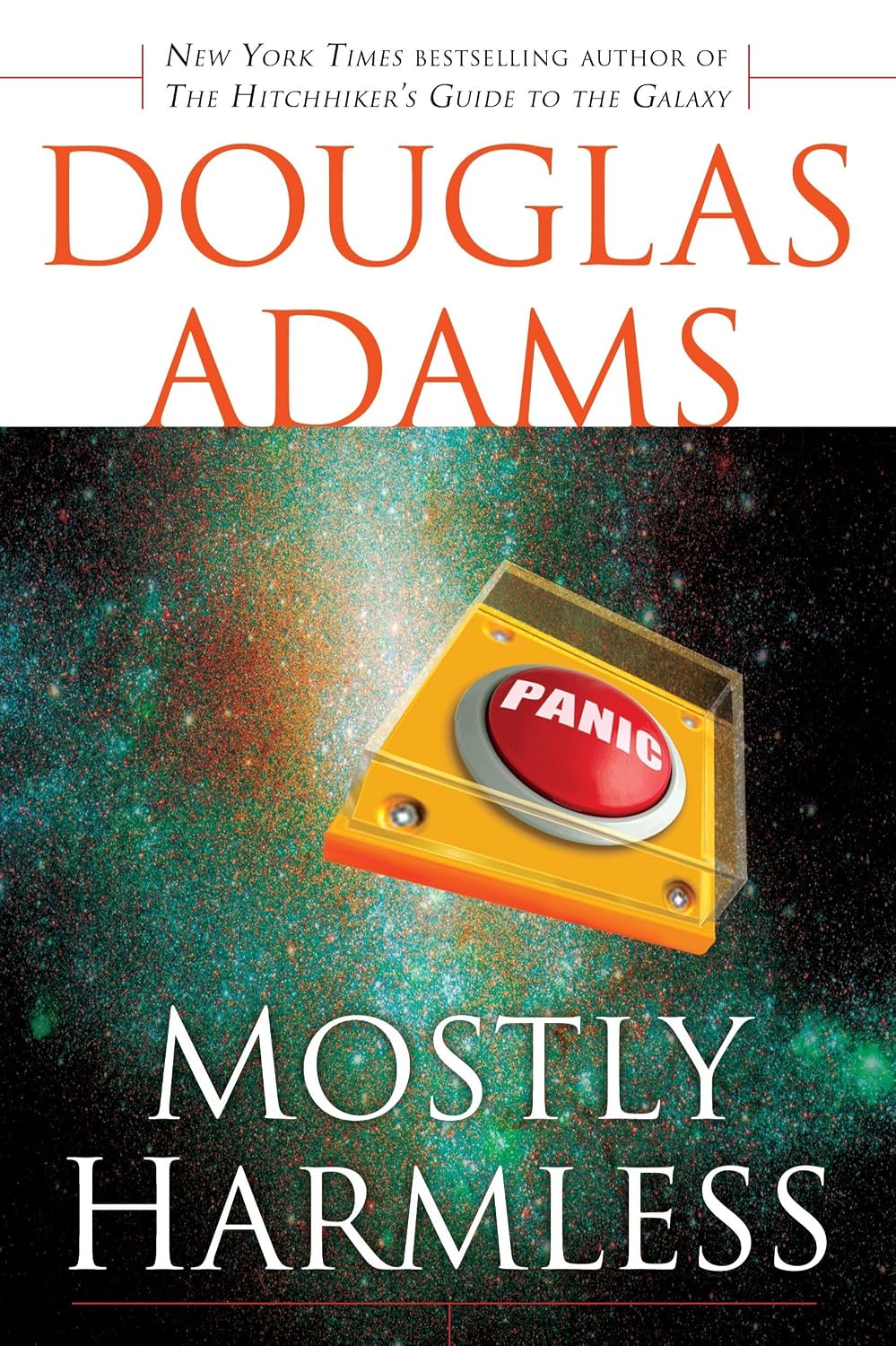
Cover of another edition
Mostly Harmless, by Douglas Adams
About this workSummary, languages, provenance, and download
What you will learnThe main threads to follow while reading
Compare competing versions of events and track what the characters can still treat as certain.
In a few words (short summary)The book’s argument, structure, and limits
The fifth novel returns to Arthur Dent, Ford Prefect, and those around them in a universe of competing versions.
The final novel shifts Arthur Dent’s and Ford Prefect’s bearings again. Divergent realities, decisions made by the Guide’s publisher, and family ties make any simple account of Earth and its disappearance harder to sustain.
This record contains the anthology’s fifth novel. The author biography and final notes in the file remain outside the narrative text.
Four-page AI synthesisA complete reading to browse without leaving the page
1. A story whose ground will not stay still
The novel opens by making orderly history look unreliable. Time travel has left galactic historians unable to sort causes from consequences, while the many possible states of Earth make even the idea of home uncertain. A tiny event may lead somewhere immense. This opening frames the separate paths of Arthur Dent, Ford Prefect, and two versions of Trillian. Their problems are personal, but they unfold in a universe where the identity of a planet or a person no longer guarantees a single, stable account of what happened.
A Grebulon reconnaissance ship supplies the first sustained example. A meteorite damages its memory and destroys the equipment that would have detected the damage. Robots sent to fetch a backup mission module fall through the hole, taking the module with them. The crew lose their memories and settle on remote, cold Rupert, where they monitor Earth. They receive its broadcasts and become interested in horoscopes. A technical failure has produced a group that cannot recall its purpose and now searches the material it watches for directions about its future.
On one Earth, Tricia McMillan is trying to build a career in American television. She understands performance and can conduct a punishing interview, but she also has advanced training in mathematics and astrophysics. Her attack on the astrologer Gail Andrews exposes an older hurt. Years earlier, she declined to leave with a visitor from space and has felt ever since that she missed another life. Gail hears that regret beneath her anger. Soon the Grebulons come for Tricia: they want her to recalculate horoscopes for the sky seen from Rupert. She agrees, also recognizing an extraordinary journalistic opportunity.
Arthur is looking less for a new opportunity than for somewhere he can return to. Fenchurch disappeared during a routine hyperspace trip, vanishing even from the passenger list. Arthur learns that people whose lives began in the Plural zones are vulnerable to such accidents. On NowWhat he finds what he sought geographically, then realizes it is the right planet in the wrong universe. His problem is therefore more exacting than choosing a destination. He wants Fenchurch and the particular Earth on which he lived, while the available worlds offer similarities that do not restore either one.
2. Three journeys through institutions and imperfect homes
Ford finds that the Hitchhiker’s Guide to the Galaxy has been taken over. Its offices retain a familiar layout, but their staff and ambitions have changed. The new editor, Vann Harl, represents InfiniDim Enterprises. His plan is to make one Guide that can be sold across a multitude of futures to wealthy customers. Ford has already experienced what the publishing business does to knowledge: editors reduced fifteen years of his Earth research to two words, “Mostly Harmless.” The new ownership extends that habit of reduction from the text to the product’s entire purpose.
Using Harl’s identity card and an excessively happy security robot he names Colin, Ford gets into the building’s protected areas. He discovers a new Guide that looks like a black disk and can unfold into a bird. The room is guarded in a building occupied by figures who remind him of Vogons. Ford manages to mail the object to himself, care of Arthur. His escape depends both on improvisation and on weaknesses in systems designed to be secure. The episode keeps returning to the gap between what an institution claims its technology can do and what happens when someone uses it unexpectedly.
Arthur, meanwhile, tries to get answers. The prophets of Hawalius offer reports from the future, statements about perception, and advice whose usefulness is open to question. He searches for a livable planet and finds that familiar appearances settle little. Bartledan has breathable air, green hills, and people who look human. They do not, however, breathe or wish for anything. Arthur comes to see how much of his own life consists of wanting, hoping, and regretting. A spacecraft accident eventually takes him to Lamuella, where he alone survives.
On Lamuella, Arthur finds a small but genuine place in village life. People value the sandwiches he makes with extraordinary care, especially from the meat of the seasonally passing Perfectly Normal Beasts. He knows the work, the food, and the local routines. When Trillian finds him, he can sincerely say that he is happy there. The novel does not present this settlement as permanent safety. The mark of his crash remains visible in the next valley, and Trillian’s arrival brings a responsibility for which he has had no preparation.
3. A daughter, a watch, and a Guide that selects events
Trillian introduces Arthur to their daughter Random and then leaves. Arthur must begin being a father almost at once, while Random is expected to live with a man she does not know. She has grown up moving through space and time, accustomed to feeling that she is in the wrong place at the wrong moment. Lamuella’s regular days disturb her. Arthur spends what time he can with her, but their attempts to talk often turn into conflict. Shared genes cannot supply a shared past, and their views of Trillian are painfully different.
Arthur’s old mechanical watch briefly gives them a way to speak. Random cannot see why it needs resetting, or why its mechanism is built into the object, when her wrist device adjusts itself to each world. Arthur explains where the watch was made, what it cannot do, and why he keeps it. It lets them discuss origin and duration without asking Random to inhabit his memories. A moment of closeness follows, then breaks when she voices her anger toward her mother. Arthur later finds that she has damaged the knives on which his sandwich making depends.
The parcel Ford sent arrives at Arthur’s home. Random takes it and runs toward the crash site, the one place she knows her father dreads revisiting. There she opens the package and finds the black disk. The new Guide unfolds into a bird and tests how she perceives space and time. Using the rain, it shows her images of Earth and of a woman who looks almost like her mother. It describes these differences along an axis of probability: some versions of Earth exist, while others disappear. Random has said she has no home, and the demonstration offers her the prospect of seeing one.
The bird says it can secure a lift by acting on the chain of events before a ship arrives. A spacecraft appears almost immediately, and Random leaves before Arthur can reach her. Ford later turns up on Lamuella and explains why he fears the new Guide. It would perceive every possible universe and could arrange coincidences to serve its purposes. The commercial promise of a product sold everywhere thus conceals a vast power to intervene. Ford does not yet know whose interests the bird serves, but he sees that the fortunate events it grants one person may only be steps toward a different end.
4. Where the journeys meet, and where the evidence stops
When Arthur meets Ford again, their urgent concerns collide. Arthur wants his daughter back; Ford wants to stop the new Guide. At first, each struggles to grasp the scale of the other’s problem. Their conversation nevertheless joins paths the novel has kept apart: Ford’s parcel passed through Arthur’s hands, Random used its contents to leave for Earth, and Ford believes that a technique for selecting outcomes lies behind some striking coincidences. Arthur and Ford then leave the crash site and reach the plain crossed by an immense herd of Perfectly Normal Beasts.
These events give the competing realities a human cost. Tricia has built a career around a journey she once refused; another Trillian travels widely and leaves her daughter with Arthur. Random has identifiable parents but little settled history with either of them. Arthur establishes a home on Lamuella through repeated, useful work, then risks losing it as he tries to protect his child. Ford sees the Guide, once meant to help travellers find their way, become something that may direct events themselves. In each story, a possibility elsewhere unsettles a life that had begun to take shape here.
The satire works through equally specific systems. A spacecraft cannot diagnose the breach that destroyed its diagnostic equipment. Editors strip Guide submissions of material that might interest readers. Security accepts an identity card while examining the wrong person. Windows described as impregnable become vulnerable after they are altered for a new ventilation scheme. These mechanisms are funny because their rules are followed so faithfully. They become more troubling when a commercial organization obtains a device that may act on probability itself, where the consequence of a procedure need not arrive after the decision that produced it.
The supplied evidence stops at the beginning of Arthur and Ford’s passage across the plain, halfway through a sentence describing the herd. It contains neither the rest of that journey nor the novel’s ending. It cannot establish where Random arrives, what the Grebulons finally do, or how the Guide’s actions conclude. At the last point supported here, three questions remain open: whether Arthur can reach his daughter, whether Ford can counter the bird, and whether a favourable event can still be trusted when another agent may have arranged the conditions for it to occur.
Synthesis generated by GPT-5.6 from the normalized text of the work. It is a reading aid, not a substitute for reading or citing the text.
- Availability
- Text available
- Text quality
- Automatic checks passed
- Text format
- Digital text extracted from the document
- Document type
- Author’s text
- Usage rights
- Authorized for this project
- Excerpts
- 231
Mostly Harmless, by Douglas Adams section 2
HTML section 2, excerpt 1/7
Chapter 1
The history of the Galaxy has got a little muddled, for a number of reasons: partly because those who are trying to keep track of it have got a little muddled, but also because some very muddling things have been happening anyway.
One of the problems has to do with the speed of light and the difficulties involved in trying to exceed it. You can't. Nothing travels faster than the speed of light with the possible exception of bad news, which obeys its own special laws. The Hingefreel people of Arkintoofle Minor did try to build spaceships that were powered by bad news but they didn't work particularly well and were so extremely unwelcome whenever they arrived anywhere that there wasn't really any point in being there.
So, by and large, the peoples of the Galaxy tended to languish in their own local muddles and the history of the Galaxy itself was, for a long time, largely cosmological.
Which is not to say that people weren't trying. They tried sending off fleets of spaceships to do battle or business in distant parts, but these usually took thousands of years to get anywhere. By the time they eventually arrived, other forms of travel had been discovered which made use of hyperspace to circumvent the speed of light, so that whatever battles it was that the slower-than-light fleets had been sent to fight had already been taken care of centuries earlier by the time they actually got there.
This didn't, of course, deter their crews from wanting to fight the battles anyway. They were trained, they were ready, they'd had a couple of thousand years sleep, they'd come a long way to do a tough job and by Zarquon they were going to do it.
HTML section 2, excerpt 2/7
This was when the first major muddles of Galactic history set in, with battles continually re-erupting centuries after the issues they had been fought over had supposedly been settled. However, these muddles were as nothing to the ones which historians had to try and unravel once time-travel was discovered and battles started pre-erupting hundreds of years before the issues even arose. When the Infinite Improbability Drive arrived and whole planets started turning unexpectedly into banana fruitcake, the great history faculty of the University of MaxiMegalon finally gave up, closed itself down and surrendered its buildings to the rapidly growing joint faculty of Divinity and Water Polo, which had been after them for years.
Which is all very well, of course, but it almost certainly means that no one will ever know for sure where, for instance, the Grebulons came from, or exactly what it was they wanted. And this is a pity, because if anybody had known anything about them, it is just possible that a most terrible catastrophe would have been averted-or at least would have had to find a different way to happen.
Click, hum.
The huge grey Grebulon reconnaissance ship moved silently through the black void. It was travelling at fabulous, breath-taking speed, yet appeared, against the glimmering background of a billion distant stars to be moving not at all. It was just one dark speck frozen against an infinite granularity of brilliant night.
On board the ship, everything was as it had been for millennia, deeply dark and silent.
Click, hum.
At least, almost everything.
Click, click, hum.
Click, hum, click, hum, click, hum.
Click, click, click, click, click, hum.
Hmmm.
HTML section 2, excerpt 3/7
A low level supervising program woke up a slightly higher level supervising program deep in the ship's semi-somnolent cyberbrain and reported to it that whenever it wentclick all it got was ahum .
The higher level supervising program asked it what it was supposed to get, and the low level supervising program said that it couldn't remember exactly, but thought it was probably more of a sort of distant satisfied sigh, wasn't it? It didn't know what this hum was. Click, hum, click, hum. That was all it was getting.
The higher level supervising program considered this and didn't like it. It asked the low level supervising program what exactly it was supervising and the low level supervising program said it couldn't remember that either, just that it was something that was meant to goclick ,sigh every ten years or so, which usually happened without fail. It had tried to consult its error look-up table but couldn't find it, which was why it had alerted the higher level supervising program to the problem.
The higher level supervising program went to consult one of its own look-up tables to find out what the low level supervising program was meant to be supervising.
It couldn't find the look-up table.
Odd.
It looked again. All it got was an error message. It tried to look up the error message in its error message look-up table and couldn't find that either. It allowed a couple of nanoseconds to go by while it went through all this again. Then it woke up its sector function supervisor.
HTML section 2, excerpt 4/7
The sector function supervisor hit immediate problems. It called its supervising agent which hit problems too. Within a few millionths of a second virtual circuits that had lain dormant, some for years, some for centuries, were flaring into life throughout the ship. Something, somewhere, had gone terribly wrong, but none of the supervising programs could tell what it was. At every level, vital instructions were missing, and the instructions about what to do in the event of discovering that vital instructions were missing, were also missing.
Small modules of software-agents-surged through the logical pathways, grouping, consulting, re-grouping. They quickly established that the ship's memory, all the way back to its central mission module, was in tatters. No amount of interrogation could determine what it was that had happened. Even the central mission module itself seemed to be damaged.
This made the whole problem very simple to deal with. Replace the central mission module. There was another one, a backup, an exact duplicate of the original. It had to be physically replaced because, for safety reasons, there was no link whatsoever between the original and its backup. Once the central mission module was replaced it could itself supervise the reconstruction of the rest of the system in every detail, and all would be well.
Robots were instructed to bring the backup central mission module from the shielded strong room, where they guarded it, to the ship's logic chamber for installation.
HTML section 2, excerpt 5/7
This involved the lengthy exchange of emergency codes and protocols as the robots interrogated the agents as to the authenticity of the instructions. At last the robots were satisfied that all procedures were correct. They unpacked the backup central mission module from its storage housing, carried it out of the storage chamber, fell out of the ship and went spinning off into the void.
This provided the first major clue as to what it was that was wrong.
Further investigation quickly established what it was that had happened. A meteorite had knocked a large hole in the ship. The ship had not previously detected this because the meteorite had neatly knocked out that part of the ship's processing equipment which was supposed to detect if the ship had been hit by a meteorite. The first thing to do was to try to seal up the hole. This turned out to be impossible, because the ship's sensors couldn't see that there was a hole, and the supervisors which should have said that the sensors weren't working properly weren't working properly and kept saying that the sensors were fine. The ship could only deduce the existence of the hole from the fact that the robots had clearly fallen out of it, taking its spare brain, which would have enabled it to see the hole, with them.
The ship tried to think intelligently about this, failed, and then blanked out completely for a bit. It didn't realise it had blanked out, of course, because it had blanked out. It was merely surprised to see the stars jump. After the third time the stars jumped the ship finally realised that it must be blanking out, and that it was time to take some serious decisions.
It relaxed.
HTML section 2, excerpt 6/7
Then it realised it hadn't actually taken the serious decisions yet and panicked. It blanked out again for a bit. When it awoke again it sealed all the bulkheads around where it knew the unseen hole must be.
It clearly hadn't got to its destination yet, it thought, fitfully, but since it no longer had the faintest idea where its destination was or how to reach it, there seemed to be little point in continuing. It consulted what tiny scraps of instructions it could reconstruct from the tatters of its central mission module.
"Your!!!!!!!!!!!!!!! year mission is to!!!!!!!!!!!!!!!!!!!!,!!!!!!!!!!!!!!!!!!!!, land!!!!!!!!!!!!!!! a safe distance!!!!!!!!!!..................., land...............
monitor it.!!!!!!!!!!!!!!!..."
All of the rest was complete garbage.
Before it blanked out for good the ship would have to pass on those instructions, such as they were, to its more primitive subsidiary systems.
It must also revive all of its crew.
There was another problem. While the crew was in hibernation, the minds of all of its members, their memories, their identities and their understanding of what they had come to do, had all been transferred into the ship's central mission module for safe keeping. The crew would not have the faintest idea of who they were or what they were doing there. Oh well.
Just before it blanked out for the final time, the ship realised that its engines were beginning to give out too.
The ship and its revived and confused crew coasted on under the control of its subsidiary automatic systems, which simply looked to land wherever they could find to land and monitor whatever they could find to monitor.
HTML section 2, excerpt 7/7
As far as finding something to land on was concerned, they didn't do very well. The planet they found was desolately cold and lonely, so achingly far from the sun that should warm it, that it took all of the Envir-O-Form machinery and LifeSupport-O-Systems they carried with them to render it, or at least enough parts of it, habitable. There were better planets nearer in, but the ship's Strateej-O-Mat was obviously locked into Lurk mode and chose the most distant and unobtrusive planet and, further-more, would not be gainsaid by anybody other than the ship's Chief Strategic Officer. Since everybody on the ship had lost their minds no one knew who the Chief Strategic Officer was or, even if he could have been identified, how he was supposed to go about gainsaying the ship's Strateej-O-Mat.
As far as finding something to monitor was concerned, though, they hit solid gold.