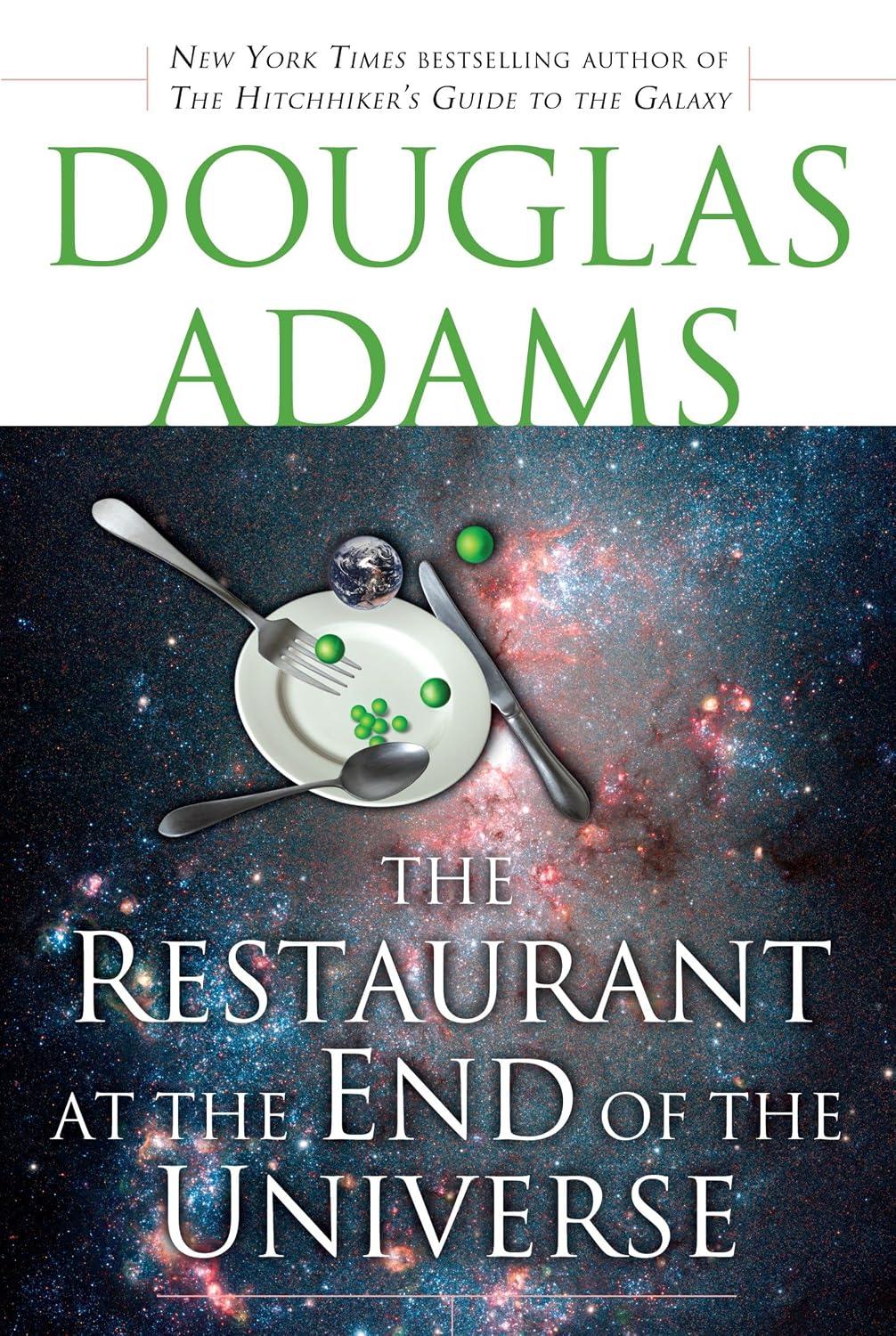
Cover of another edition
The Restaurant at the End of the Universe, by Douglas Adams
About this workSummary, languages, provenance, and download
What you will learnThe main threads to follow while reading
Observe how the spectacle of the end of the world changes the search for an explanation, and separate the characters’ journey from the stories sold to them.
In a few words (short summary)The book’s argument, structure, and limits
The second novel carries Arthur Dent and his companions toward a restaurant set at the end of time.
The Heart of Gold crew continues its journey after the revelation of the answer 42. Milliways turns the end of the Universe into a spectacle and extends the satire of institutions, certainty, and cosmological explanation.
The text is isolated as the second novel in the HTML anthology. Its dedications and the other books are kept separate from its prose.
Four-page AI synthesisA complete reading to browse without leaving the page
1. An answer without a question, and survivors marked for death
The novel resumes with a calculation that has yielded forty-two and settled nothing. Deep Thought found the Answer to the Ultimate Question, but Earth was built to discover what the question was. The Vogons destroyed the planet just before the result could be read. Arthur Dent and Trillian, its two human survivors, are therefore the remaining traces of an experiment they never knew they belonged to. The opening offers rival accounts of how the Universe began, including one involving a divine sneeze. Their variety makes the prospect of a single, final explanation doubtful from the start.
The unfinished search has a determined opponent. Gag Halfrunt, a psychiatrist, pays the Vogon captain Jeltz to kill the survivors because a settled meaning of life would threaten his profession’s business. Jeltz attacks the Heart of Gold, which also carries Ford Prefect and Zaphod Beeblebrox. The ship’s helplessness has a ludicrous but exact cause. Arthur has described tea at such length to a drink machine that cannot make it that the ship’s computer has devoted all its resources to the problem. Neither its ordinary engines nor its Improbability Drive will respond while the Vogons fire.
Zaphod holds a séance and summons his great-grandfather. The ghost presses him about a mission Zaphod once concealed inside a locked section of his own brain: finding whoever holds real power behind the Galactic presidency. Zaphod resents being directed by his former self, though he is willing to ask a dead relative to save his present one. His quarrel gives the pursuit a personal edge. He wants the freedom to enjoy himself, while decisions he can no longer remember, and the ship’s Improbability field, continue to shape where he goes.
The Heart of Gold escapes in a form Halfrunt mistakes for its destruction. Ford, Arthur and Trillian remain aboard a silent ship, but Zaphod and Marvin have vanished. Their separation sets up two journeys that will meet again. It also establishes the novel’s rhythm: a physical emergency opens onto a cosmic question, only for a machine or institution to redirect the trouble. Tea, psychiatry and the presidency have more than comic value here. Each has a purpose it claims to serve, and each becomes absurd when its own procedures matter more than the people caught inside them.
2. From the Guide’s offices to dinner at the end of time
Zaphod reappears on Ursa Minor Beta near the offices of the publisher of The Hitchhiker’s Guide to the Galaxy. The Guide is cheap, popular and reassuring, yet its errors can be lethal. Its editors maintain that when the book and reality disagree, reality is at fault. The building extends the joke about misplaced authority: reception resents the hitchhikers the book serves, and an elevator programmed to foresee the future refuses to take Zaphod up. He is looking for Zarniwoop because a message from the sealed part of his mind has told him to do so.
An attack on the offices carries Zaphod and Marvin toward Frogstar World B. Marvin stops a battle robot by talking it into destroying the floor beneath itself. On Frogstar, Zaphod is taken to the Total Perspective Vortex. It shows its victims all of creation and the almost invisible point they occupy within it. He emerges delighted, convinced that the machine has confirmed his supreme importance. That apparent triumph changes shape when Zarniwoop later explains that part of Zaphod’s journey took place inside an electronically constructed universe. The evidence invites a fresh reading of the Vortex’s verdict.
Zarniwoop is waiting inside a ship that has remained at an airport for nine hundred years because its supplies of lemon-soaked paper napkins are incomplete. He explains the route into his artificial universe and reveals that the Heart of Gold has been travelling in Zaphod’s pocket as a small metal model. The ship grows back to full size, reuniting its occupants. Zaphod rejects the plan in which he has been made to take part, but Zarniwoop says he cannot escape the Improbability field. Recovering the ship restores the crew’s freedom of movement without resolving who is directing its journey.
Zaphod’s next request is simpler: food. The Heart of Gold takes the crew to Milliways, where they initially think they have died before learning that they have travelled through time. A protective field encloses the restaurant while its machinery carries diners across the Universe’s final moment and back. Guests can watch creation end, then return to their own eras. The Guide, the Vortex and Milliways each package something too large to grasp directly. One claims authority over facts, one assigns a person a place in infinity, and one sells the end of everything as an evening out.
3. The last show, an uneasy meal and a stolen ship
At Milliways, the end of the Universe unfolds beyond a golden dome while a band plays and Max, the host, works the tables. He turns dying stars into a carefully timed act and jokes with guests who expect to go home afterwards. The repetition of the final moment creates the restaurant’s disturbing distance from its subject: catastrophe can be watched over dinner and reviewed like any other performance. Arthur struggles to adopt that attitude. His unease matters because the room’s glitter, music and efficient service cannot make the event outside it ordinary.
The Dish of the Day brings that unease down to the table. A speaking animal offers the diners particular cuts of its own body. Arthur recoils from eating a creature that has come to recommend its shoulder; Zaphod argues that its willingness is preferable to eating an animal that objects. The exchange leaves hunger, consent and slaughter in uncomfortable proximity without settling them in a neat rule. Elsewhere in the restaurant, the famous musician Hotblack Desiato is spending a year dead for tax purposes. Death can be a transaction here as well as a spectacle.
Marvin calls from the car park, where he has waited an immense span of time for the others to arrive. Zaphod and Ford go down to find him and take a sleek black ship without learning what he knows about it. Meanwhile the prophet Zarquon finally appears before followers who have waited for his return. He barely has time to speak before the Universe ends. The prophecy is fulfilled, yet the promised arrival yields almost no explanation. As with the dinner, witnessing an extraordinary event gives the audience much less understanding than it expected.
The stolen ship belongs to Disaster Area, the rock group whose concert act sends it into a sun. Marvin knew its purpose because he had parked it. Its autopilot will not yield to the thieves, and its emergency teleport has no working guidance system. Ford and Arthur use it and arrive together on another spacecraft; the supplied passages later place Zaphod and Trillian back on the Heart of Gold with Zarniwoop. The concert ship’s impact eventually changes Kakrafoon’s desert and removes the telepathy that afflicted its people. That fortunate result does not make the crew’s escape any less desperate.
4. An ark in the past and a ruler still out of reach
Ford and Arthur discover that the teleport has sent them far into the past aboard Golgafrincham’s B Ark. Thousands of containers they first take for coffins hold people preserved for the voyage. The captain, taking a bath on the bridge, tells them the official plan: three arks were to evacuate a doomed planet. The A Ark would carry leaders, scientists and artists; the C Ark, the people who made and did things; the B Ark, the supposed middlemen. Its passengers were sent first, on a course programmed to end in a crash.
The Guide supplies the part of the story the captain does not know. Golgafrincham’s impending doom was invented to rid the planet of a third of its population. Those who remained lived on, then died of a disease caught from a dirty telephone. The detail overturns the confident label of uselessness applied to the people expelled: work dismissed as trivial may have kept others alive. After the crash, Ford and Arthur watch survivors struggle out across the new world. Ford thinks they may manage to live there. The supplied passages do not establish the colony’s later history or the two travellers’ fate.
On the other branch of the story, Zarniwoop continues his search for the being said to rule the Universe. Zaphod and Trillian find him aboard the Heart of Gold, where he has programmed coordinates for an imminent meeting. The last supplied passage moves to a world hidden by an Improbability field. In a rain-battered shack, a man tries to feed his cat and hesitates even to predict what will happen if it refuses the fish. The sequence strongly suggests a connection to Zarniwoop’s destination, but the evidence stops before the meeting. Its outcome cannot be reconstructed from these passages.
These strands carry forward the opening problem without supplying the missing Ultimate Question in the available evidence. The B Ark exposes the cost of treating a social classification as certain knowledge. The man in the shack presents a striking counterpoint to the search for a universal ruler: he doubts what he can infer about the creature directly in front of him. Milliways has already shown that seeing an ending does not explain its cause or meaning. Across the journeys, assured answers keep appearing, while the plot asks who issued them, whose interests they serve and what remains outside their account.
Synthesis generated by GPT-5.6 from the normalized text of the work. It is a reading aid, not a substitute for reading or citing the text.
- Availability
- Text available
- Text quality
- Automatic checks passed
- Text format
- Digital text extracted from the document
- Document type
- Author’s text
- Usage rights
- Authorized for this project
- Excerpts
- 197
The Restaurant at the End of the Universe, by Douglas Adams section 1
HTML section 1
There is a theory which states that if ever anyone discovers exactly what the Universe is for and why it is here, it will instantly disappear and be replaced by something even more bizarre and inexplicable.
There is another theory which states that this has already happened.