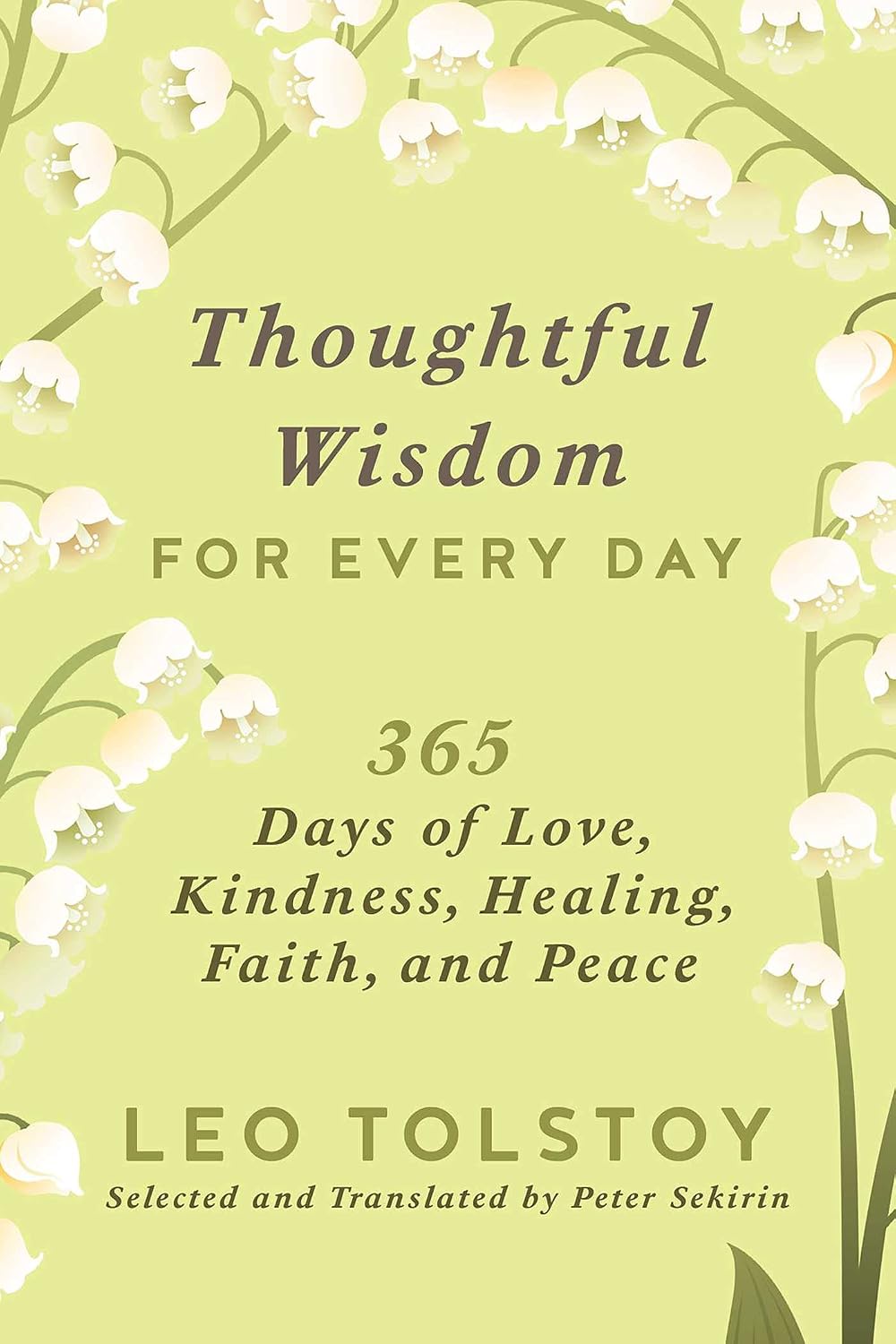
Cover of another edition
Leo Tolstoy’s Thoughtful Wisdom for Every Day, Selected, Translated, and Compiled by Peter Sekirin
About this workSummary, languages, provenance, and download
What you will learnThe main threads to follow while reading
For each date, identify the theme, distinguish explicitly attributed quotations from sayings without a named author, and examine how their sequence builds a practical meditation.
In a few words (short summary)The book’s argument, structure, and limits
This English volume organizes daily readings around themes such as faith, love, pride, truth, effort, and death. Peter Sekirin selected, translated, and compiled it. Some sayings carry an explicit attribution, while others appear without a named author.
This manifestation is the first Arcade/Skyhorse hardcover edition, published in 2021. The copyright page credits Peter Sekirin with the English-language translation, introduction, and compilation, under a 2005 copyright. The contents also include Tolstoy’s introduction to For Every Day. Sekirin’s introduction presents Thoughtful Wisdom for Every Day as the 1909 final volume in a sequence of three compilations, following The Thoughts of Wise Men and A Circle of Reading, published in English as A Calendar of Wisdom.
Each date has a theme and gathers several moral or spiritual propositions. The excerpts address subjects including the examination of pride, love of others, inner effort, violence, wealth, the present, and death. Names such as Muhammad, Blaise Pascal, Arthur Schopenhauer, Ralph Waldo Emerson, and Angelus Silesius appear beneath particular sayings. The lack of a credit on other passages does not, by itself, support assigning every sentence to Tolstoy.
Four-page AI synthesisA complete reading to browse without leaving the page
A Calendar for Moral Orientation
Thoughtful Wisdom for Every Day is a compilation of daily readings, not a continuous treatise or a uniform collection of Tolstoy’s own sayings. This English manifestation, issued by Arcade/Skyhorse in 2021, incorporates Peter Sekirin’s translation, introduction, and compilation, copyrighted in 2005. Sekirin presents the 1909 work as the last part of a sequence that began with The Thoughts of Wise Men and continued with A Circle of Reading, published in English as A Calendar of Wisdom. The contents also list Tolstoy’s introduction to For Every Day, although the supplied evidence does not provide enough of that introduction to reconstruct its argument.
The project addresses a plain but encompassing question: how should a person live while continually exposed to desire, pride, public opinion, fear, and material self-interest? Instead of answering through one sustained argument, the book distributes the question across the year. Each date receives a subject and several propositions that can be considered together. Some sayings are expressly credited to Muhammad, Pascal, Schopenhauer, Emerson, Montaigne, Ruskin, Marcus Aurelius, and other thinkers. Others appear without a name. Lack of a credit does not establish that every such sentence originated with Tolstoy, especially in a volume explicitly selected, translated, and compiled by Sekirin.
A persistent diagnosis contrasts two understandings of life. The first identifies a person with the separate body, its needs, social position, and reputation. It generates rivalry, dissatisfaction, fear of loss, and the wish to dominate. The second locates genuine life in spirit, understood as shared by human beings and, more broadly, by other living creatures. An image of different vessels containing the same water gives this proposition a concrete form: appearances and conditions vary, but the same spiritual life inhabits them. An ethics follows from that unity. To harm another is also to cut oneself away from the whole to which one belongs.
The faith supporting this outlook is not defined primarily by miracles, ritual, or obedience to an institution. It is an orientation toward God, the world, and other people, tested by intelligence, conscience, and conduct. Historical religions contain changing rules, the collection argues, alongside an enduring law: love God and one’s neighbor. Sectarian claims to exclusive truth, ecclesiastical display, and unthinking belief therefore face repeated criticism. Honest doubt need not destroy faith, since it may clarify what a person means by “God.” From its opening cycle onward, the calendar joins spiritual life to critical examination rather than passive repetition.
The Monthly Cycle and the Daily Progression
The book’s unity comes less from a linear argument than from a thematic cycle repeated each month with variations. The opening days generally return to faith, soul, spiritual unity, God, and universal love. They are followed by sin, temptation, desire, work, wealth, anger, pride, vanity, judgment, violence, and false science. The latter part of a cycle emphasizes effort, self-sacrifice, humility, truth, words, actions, and thoughts. Its closing days move toward the present, the problem of evil, death, life after death, and happiness. A subject may recur, shift position, or disappear in a particular month, and a few dates combine more than one theme.
Repetition serves more than memory. It revisits recurring difficulties from different directions and makes the calendar an exercise in renewed examination. A reading on pride may begin with excessive self-love, extend to nationalism or social hierarchy, and end by showing how self-satisfaction obstructs improvement. A day devoted to words connects restraint, refusal of gossip, and the lasting responsibility created by speech. A meditation on effort may bring together the correction of habit, resistance to anger, and persistence after relapse. Individual entries can therefore form small progressions even when their component sayings have different sources.
The main conceptual movement is from bodily rule toward spiritual rule. The body is not treated as useless: it must be fed, rested, and put to work. It becomes tyrannical when its demands multiply for pleasure, luxury, or distinction. Plain food, sexual restraint, fewer needs, and suspicion of alcohol belong to this discipline. The collection also values manual work, especially work with the soil, because it meets real needs, settles the mind, and exposes one’s dependence on other people’s labor. Privileged idleness consequently appears as an appropriation of what others produce, not as an innocent private choice.
Such discipline matters only if it changes relationships. Love supplies the book’s most consistent practical test: an action is good when it increases union among people. The rule extends to enemies, strangers, the poor, children, and animals. Loyalty to family or nation cannot excuse injury to people outside that circle. Compassion for living creatures develops into criticism of hunting, slaughter, and meat eating. The calendar therefore does not place abstract mysticism beside a separate code of behavior. Its claim that one spirit lives in all is repeatedly translated into uses of the body, language, labor, property, and power.
From Inner Reform to Social Criticism
Thought is the chief site of moral decision. Harmful acts begin in representations, desires, or anger that might have been recognized before becoming habits. Sin is pictured first as a light web, then, through repetition, as a rope and finally an iron chain. Improvement likewise begins with attention: examine an impulse, delay a remark, acknowledge a fault, and resume the effort after slipping backward. Moral effort is measured neither by the prestige of its outcome nor by public approval, but by the resistance actually overcome. The collection also rejects reliance on miraculous correction. Divine intervention cannot replace work already indicated by conscience.
This priority given to the inner life does not entail social withdrawal. Wealth is condemned when it enables the rich to live from poor people’s labor, turns abundance into a claim of personal merit, or gives away as charity a small portion of what has been unjustly accumulated. Giving has spiritual value only when it requires a genuine sacrifice. Work, in turn, is not good merely because it is strenuous or abundant. Its object and effects matter. The criticism covers the idle rich, but also futile busyness, empty conversation, and frantic activity used to conceal a lack of purpose. At times, doing nothing is preferable to doing harm under the appearance of usefulness.
The same reasoning grounds opposition to punitive judgment, capital punishment, and war. Punishment presented as an attempt to improve an offender often disguises revenge. Modern imprisonment is compared to older forms of physical cruelty, while political violence is accused of trying to impose freedom, equality, or brotherhood by force. No appeal to state necessity can reconcile killing with a law declaring all people brothers and sisters. External power cannot reform people who remain inwardly unchanged. The proposed answer is not a rival institutional technique, but personal refusal to return evil for evil, forgiveness, and sustained correction of one’s own conduct.
“False science” receives a parallel criticism. The collection does not deny specialized knowledge, but disputes its claim to answer the questions of identity and conduct. Accumulating information, repeating books, or using obscure language can feed vanity without producing wisdom. Saying “I do not know,” speaking simply, and judging independently become intellectual virtues. A truth accepted solely on authority remains external, whereas a truth grasped through reflection and experience becomes part of the person. The same standard applies to religion: neither a doctrine’s age, its grandeur, nor the number of its adherents removes the need to ask whether it actually leads to love.
The Present, Death, and the Collection’s Tensions
The final days of each cycle return moral discipline to the experience of time. The past cannot be altered, and much of the future remains hidden. Good must therefore be done in the present without demanding full knowledge of its consequences or a later reward. Living in the present does not mean pursuing immediate sensation. It means treating the current moral task as the only available point of action. This focus connects small decisions to the larger purpose: withhold an injurious remark, refrain from wrongdoing when no positive deed is possible, work honestly, and choose what unites rather than what separates.
Death gives urgency to that practice. Remembering the end should reorder a person’s concerns, since wealth, reputation, and pleasure lose importance beside a limited life. Preparation for death consists less in settling property or performing a final rite than in living so that the end need not be feared. Several passages describe death as a change of condition, a return, or an exit from time. Others state plainly that what follows death cannot be known. The collection thus holds together a degree of reserve about the afterlife and confident images of spiritual continuity.
The recurring heading “There Is No Evil” reveals the book’s sharpest tension. Its entries argue that illness, loss, and suffering may become occasions for detachment and spiritual growth. At their strongest, they locate evil in the sufferer’s inward attitude. Yet the same collection commands people to relieve suffering, condemns cruelty, war, and exploitation, and demands protection for vulnerable beings. The heading cannot therefore mean that all events are morally equivalent. It reframes evil endured as possible material for inner work without making deliberately harmful actions good.
That distinction remains a necessary caution because some sayings make broad claims about the value of sickness, misfortune, and self-denial. The prescriptions concerning sexuality, celibacy, wealth, religious institutions, and telling a sick person of approaching death are similarly categorical. The fragmentary form does not always develop the circumstances needed to qualify them. Its distinctive strength lies elsewhere, in the methodical return to a small set of connections. Thoughts prepare words, words prepare actions, habits shape a person, and persons contribute to common life. The happiness reached at the year’s end is neither possession nor success. It is the alignment of conscience, universal love, just work, and acceptance of mortality.
Synthesis generated by GPT-5.6 from the normalized text of the work. It is a reading aid, not a substitute for reading or citing the text.
- Availability
- Text available
- Text quality
- Automatic checks passed
- Text format
- Digital text extracted from the document
- Document type
- Translation
- Usage rights
- Authorized for this project
- Excerpts
- 394
Leo Tolstoy’s Thoughtful Wisdom for Every Day, Selected, Translated, and Compiled by Peter Sekirin page 6
PDF page 6
Also by Peter Sekirin:
The Dostoevsky Archive
Memories of Chekhov: Accounts of the
Writer from His Family, Friends,
and Contemporaries
(translator)
The Complete Early Chekhov,
by Anton Pavlovich Chekhov
Divine and Human, by Leo Tolstoy
A Calendar of Wisdom, by Leo Tolstoy
A Night in the Cemetery: And Other
Stories of Crime and Suspense,
by Anton Chekhov
Tolstoy’s Words to Live by: Sequel to a
Calendar of Wisdom, by Leo Tolstoy,
edited by Alan Twigg