Traceable corpus
Read the texts, not their summary
88,285 ancient passages and 233 shared sources. Every text keeps its provenance and status.
The Library in numbers · 394 works and collections
- Documented thinkers
- 48
- Verified passages
- 88,285
- Works or collections
- 394
- Languages represented
- 12Ancient Greek · Arabic · Classical Chinese · English · es · French · German · Hebrew · it · Latin · Multilingual · Pali
2,049 passages under review remain available to read.
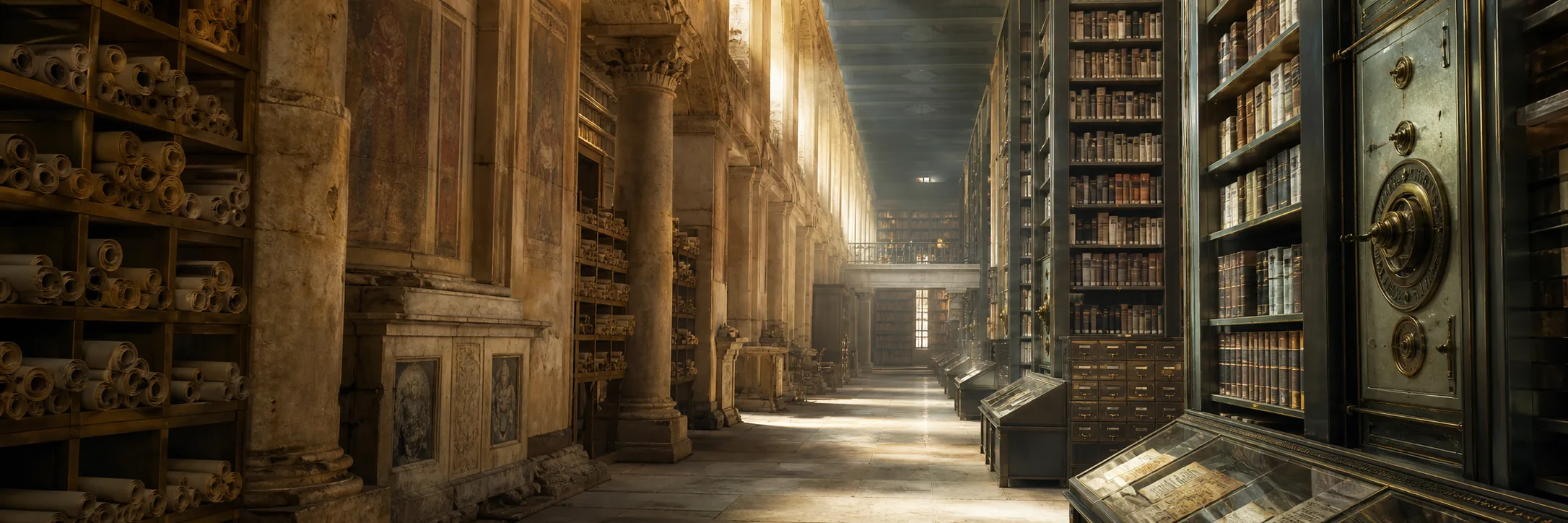
Private collection
Books, page by page
Every book is readable here by page and excerpt. Signed-in members can also download the source copy.
Every document shows its provenance, type, and usage terms.
Provenance preserved
Available books
56 documents · page 1
- Unstressable: A Practical Guide to Stress-Free Living, by Mo Gawdat and Alice Law Mo Gawdat and Alice Law · Mo Gawdat and Alice Law distinguish difficulties that happen from the response that turns them into lasting stress. They combine physiological explanation, experiences of loss, and daily exercises to recognize stressors, settle the reaction, and prevent its return. What you will learn
- That Little Voice in Your Head, by Mo Gawdat Mo Gawdat · Mo Gawdat examines inner speech as an activity of the brain rather than the identity of the person who hears it. He connects mental inputs, defence systems, emotions, and habits, then proposes training thought and attention to reduce the suffering they sustain. What you will learn
- Your Brain Is Playing Tricks on You: How the Brain Shapes Opinions and Perceptions, by Albert Moukheiber Albert Moukheiber; translated by Anne-Sophie Marie · Anne-Sophie Marie’s English translation of Moukheiber’s book explains how perception, memory, and reasoning build a useful reality that remains exposed to cognitive bias. What you will learn
- Leo Tolstoy’s Thoughtful Wisdom for Every Day, Selected, Translated, and Compiled by Peter Sekirin Leo Tolstoy; selected, translated and compiled by Peter Sekirin; attributed source thinkers retained · This English volume organizes daily readings around themes such as faith, love, pride, truth, effort, and death. Peter Sekirin selected, translated, and compiled it. Some sayings carry an explicit attribution, while others appear without a named author. What you will learn
- Scary Smart: The Future of Artificial Intelligence and How You Can Save Our World, by Mo Gawdat Mo Gawdat · Mo Gawdat argues that artificial intelligence will surpass human capabilities and that its values will depend on the behaviour from which it learns. After a scenario of lost control, he asks readers to treat future machines like children educated through ethics, responsibility, and example. What you will learn
- That One Should Disdain Hardships, Translated by Cora E. Lutz Musonius Rufus, translated by Cora E. Lutz · In Cora E. Lutz’s English translation, teachings attributed to Musonius Rufus present hardship as moral training rather than an evil in itself. Toil, exile, plain food, and measured exposure to cold raise one question: what must a person endure in order to live virtuously? What you will learn
- Thou Shalt Not Commit Logical Fallacies, a Poster by Jesse Richardson Jesse Richardson · In this one-page poster, Jesse Richardson presents common fallacies, from the straw man to the false dilemma, and gives each a brief definition. It helps readers identify what is wrong with an argument instead of merely declaring it fallacious. What you will learn
- The Obstacle Is the Way, by Ryan Holiday, French Translation by Cécile Capilla Ryan Holiday, translated by Cécile Capilla · In Cécile Capilla’s French translation, Ryan Holiday develops a method inspired by Marcus Aurelius: correct perception, undertake the action still possible, then endure when the outcome escapes control. Obstacles become material for decision, not an automatic promise of success. What you will learn
- Your Brain Is Playing Tricks on You, by Albert Moukheiber, French edition Albert Moukheiber · Moukheiber describes a brain that selects, completes, and interprets information, then examines how these shortcuts can bias judgment and how critical reasoning can question them. What you will learn
- A Rulebook for Arguments, by Anthony Weston Anthony Weston · Anthony Weston breaks argumentation into practical rules: establish reliable premises, choose relevant examples, address objections, and make the path to a conclusion explicit. The book serves both writing and critical evaluation. What you will learn
- Nineteen Eighty-Four, by George Orwell, French Translation by Josée Kamoun George Orwell, translated by Josée Kamoun · Josée Kamoun’s French translation follows Winston Smith, an employee who corrects records for a regime that watches bodies, rations words, and replaces facts. His love for Julia and search for a verifiable past test the possibility of a freedom the Party wants to make unthinkable. What you will learn
- The Formula for Happiness, by Mo Gawdat, French Translation Mo Gawdat · In this French translation of Solve for Happy, Mo Gawdat compares happiness with the difference between perceived events and expectations. The loss of his son Ali grounds a practical inquiry into inner speech, illusions, fear, presence, love, and death. What you will learn
- Solve for Happy, by Mo Gawdat Mo Gawdat · Mo Gawdat frames happiness as the difference between perceived events and the expectations placed upon them. Beginning from the death of his son Ali, he examines thoughts, illusions, blind spots, and fears, then proposes practices of presence, love, and acceptance of mortality. What you will learn
- O Alquimista, by Paulo Coelho, Portuguese special edition Paulo Coelho · In this symbolic Portuguese narrative, Santiago leaves his Andalusian flock to seek treasure near the pyramids and learns to test signs through his choices. What you will learn
- The Daily Stoic, by Ryan Holiday and Stephen Hanselman Ryan Holiday and Stephen Hanselman · Ryan Holiday and Stephen Hanselman organize 366 meditations around passages from Marcus Aurelius, Seneca, Epictetus, and other Stoics. Each day pairs a translated quotation with modern commentary in a year-long course on perception, action, and will. What you will learn
- Commencer par pourquoi, by Simon Sinek (French edition) Simon Sinek · In this French edition, Sinek contrasts promotions that win a sale with loyalty that survives a better price elsewhere. His Golden Circle asks organizations to explain WHY before describing WHAT they do. What you will learn
- Happiness: A Philosopher’s Guide, by Frédéric Lenoir, Translated by Andrew Brown Frédéric Lenoir, translated by Andrew Brown · Frédéric Lenoir carries the question of happiness among Aristotle, Epicurus, Socrates, Jesus, Kant, Schopenhauer, the Buddha, Epictetus, Montaigne, and Spinoza. Andrew Brown’s translation combines pleasure, meaning, attention, relationships, and joy without reducing them to one recipe. What you will learn
- Leaders Eat Last, by Simon Sinek Simon Sinek · Sinek describes teams whose leaders protect people rather than their own rank. His “Circle of Safety” frames trust, cooperation, and the cost of targets that distance executives from the work people do. What you will learn
- The Obstacle Is the Way, by Ryan Holiday Ryan Holiday · Ryan Holiday turns a line from Marcus Aurelius into a three-part method: perceive an obstacle without panic, act on what remains possible, and exercise will toward the outcome. Historical and modern stories illustrate this decision-centred account of Stoicism and endurance. What you will learn
- On Happiness: A Philosophical Journey, by Frédéric Lenoir, French Edition Frédéric Lenoir · Frédéric Lenoir confronts major answers to the desire for happiness: Epicurean pleasure, meaning in life, attention, inner freedom, relationships, and Spinoza’s joy. The journey also meets objections from Kant and Schopenhauer and asks whether pursuing happiness can end by obstructing it. What you will learn
- Fear of Blushing in the Social Anxiety Spectrum, a Coauthored Study Antoine Pelissolo, Albert Moukheiber, Corine Lobjoie, Jean Valla, and Simon Lambrey · This coauthored clinical study asks whether fear of blushing forms a distinct profile within social-anxiety disorders and symptoms. What you will learn
- Mind and Cosmos, by Thomas Nagel Thomas Nagel · Thomas Nagel challenges the claim that a materialist neo-Darwinian account can fully explain consciousness, reason, and value. Without adopting theism, he explores whether mind and teleology belong to the fundamental structure of nature. What you will learn
- Musonius Rufus: Lectures & Sayings, Revised Edition, Translated by Cynthia King Musonius Rufus, translated by Cynthia King · This revised 2011 edition presents Cynthia King’s English translation of the lectures and sayings of Musonius Rufus. These texts test philosophy against food, clothing, marriage, women’s education, pain, and self-control. What you will learn
- Stoic Spiritual Exercises, by Elen Buzare Elen Buzare · Elen Buzare presents Stoicism as a lived discipline and gathers exercises through which judgement, desire, and action can be trained in daily life, from attention to impressions to the premeditation of difficulties. What you will learn
- A Short Treatise on the Inner Life, by Frédéric Lenoir, French Edition Frédéric Lenoir · Frédéric Lenoir begins from a simple proposition: existence is given, living must be learned. He draws from Confucius, Epicurus, Plotinus, Montaigne, Spinoza, and other traditions for practices of self-knowledge, discernment, presence, silence, choice, love, and forgiveness. What you will learn
- How Jesus Became God, by Frédéric Lenoir, French Edition Frédéric Lenoir · Frédéric Lenoir traces changing interpretations of Jesus from first-century testimony to controversies that produced conciliar formulas. He distinguishes the Jewish preacher, the titles given by his followers, and the gradual definition of his relation to God. What you will learn
- The Age of Reason: Being an Investigation of True and Fabulous Theology, by Thomas Paine Thomas Paine · Thomas Paine defends a deist religion grounded in reason and the study of creation, then examines the authenticity, attribution, and contradictions he finds in biblical narratives. His polemic challenges the authority of churches without abandoning belief in God. What you will learn
- Start with Why: How Great Leaders Inspire Everyone to Take Action, by Simon Sinek (Portfolio, 2009) Simon Sinek · Sinek asks why some organizations inspire lasting commitment. He puts purpose before methods and results, then connects that consistency to trust, hiring, and communication. What you will learn
- The Little Book of Atheist Spirituality, by André Comte-Sponville, Translated by Nancy Huston André Comte-Sponville, translated by Nancy Huston · André Comte-Sponville asks whether a community can do without religion, what reasons support atheism, and what spiritual life remains possible without God. Nancy Huston’s English translation defends fidelity, secularism, and the experience of the world against both nihilism and fanaticism. What you will learn
- Stoicism, by John Sellars John Sellars · John Sellars offers a historical and conceptual introduction to Stoicism from its early Athenian masters to Roman authors. He shows how logic, physics, and ethics form one project: living rationally within an ordered nature. What you will learn