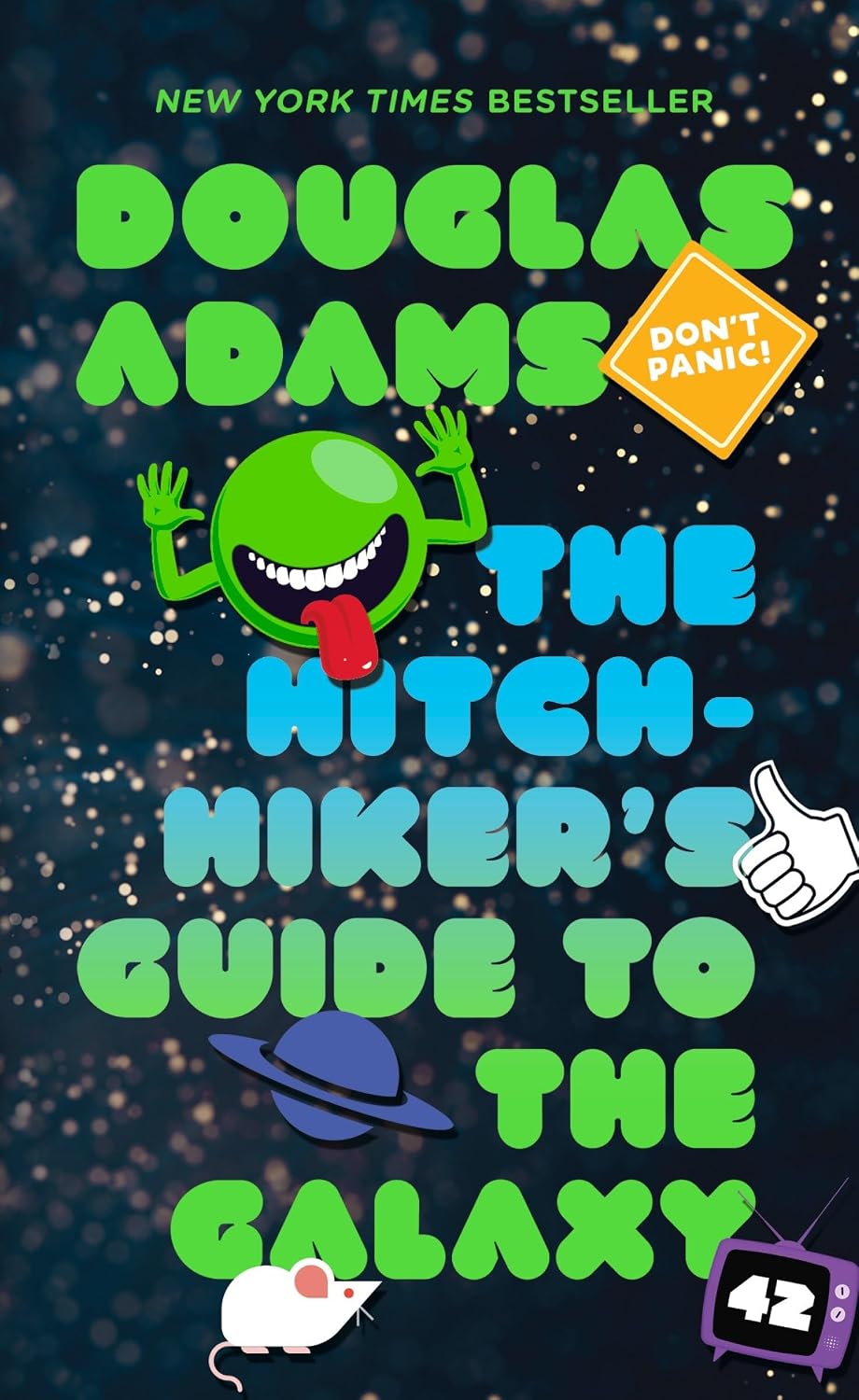
Cover of another edition
The Hitchhiker’s Guide to the Galaxy, by Douglas Adams
About this workSummary, languages, provenance, and download
What you will learnThe main threads to follow while reading
Track how the answer 42 becomes comic when its question remains unknown, then follow the shifts of perspective imposed on Arthur Dent.
In a few words (short summary)The book’s argument, structure, and limits
Arthur Dent leaves a doomed Earth and discovers a Guide in which absurdity is a survival method. The first novel introduces the answer 42.
The first novel follows Arthur Dent after the Vogons destroy Earth. Ford Prefect, a researcher for the Guide, draws him into a journey where space bureaucracy, chance, and metaphysical questions collide. The answer 42 appears here without revealing the question that would make it meaningful.
This record covers the first novel extracted from the HTML anthology. It does not stand for the four sequels or the short story in the same source file.
Four-page AI synthesisA complete reading to browse without leaving the page
A house marked for demolition
The story opens by shrinking Earth to an almost negligible spot in the Galaxy. Its inhabitants are unhappy much of the time and keep proposing solutions involving money, although money is not what is suffering. One woman finally sees how the world might be made happy, but a catastrophe prevents her from telling anyone. The novel follows that catastrophe and some of its consequences. It also follows the Hitchhiker’s Guide to the Galaxy, a celebrated book with gaps and unreliable entries. It is cheaper than its more solemn rival and carries one immediately usable instruction on its cover: don’t panic.
The first demolition is small enough to have a bulldozer parked outside Arthur Dent’s house. A bypass is about to replace his home, and Arthur lies in the mud to stop the work. The council says the plans have been available for nine months. He found them in a locked filing cabinet inside a disused lavatory. The procedure has technically been followed, while the person most affected has had no meaningful chance to respond. Mr Prosser can offer no better reason for building the bypass than the fact that bypasses are the sort of thing one builds.
Ford Prefect arrives to collect Arthur. Arthur thinks his friend comes from Guildford; Ford is actually a travelling researcher for the Guide, stranded on Earth for fifteen years after arriving from a planet near Betelgeuse. Ford persuades Mr Prosser to take Arthur’s place in front of the bulldozer and takes Arthur to the pub. He knows that ships are approaching and urges Arthur to drink. While Arthur discovers that his house has been knocked down after all, the Vogons announce a second project: Earth must be removed for a hyperspace express route.
The notice for that demolition, they say, has long been displayed in a planning office on Alpha Centauri. Their excuse repeats the council’s logic on a scale at which no human protest can stop the work. Earth is destroyed. Ford and Arthur survive by transferring aboard a Vogon ship, helped by the Dentrassis who work there as cooks. Arthur has lost both his house and his planet in a single day. The change in scale is funny, but it does not make the loss unreal to him.
Survival by guidebook and improbability
Aboard the Vogon ship, Ford gives Arthur food to help him recover from the transfer and shows him the electronic Guide. Its entry for Earth originally consists of one word, “Harmless”. Ford has managed to improve it to “Mostly harmless”, a painfully small tribute to the world Arthur has just lost. Ford also puts a Babel fish in Arthur’s ear so he can understand alien speech. The Guide offers a biological account of its translation, a joke about proving God’s nonexistence, and a darker observation: removing language barriers has not prevented wars between cultures.
The Vogon captain discovers the stowaways. Before expelling them, he makes them hear his poetry through equipment designed to intensify every detail. Arthur tries to save them by praising the poem, and Ford joins in with improvised literary commentary. It fails. As a guard drags them toward the airlock, Ford asks whether shouting at people and throwing them out of ships makes for a satisfying life. The guard admits that most of his working minutes are poor, yet promotion depends on continuing to shout and push. He carries out the order and ejects them into space.
The Guide says they can survive about thirty seconds in a vacuum, while judging rescue within that time fantastically unlikely. A ship picks them up after twenty-nine seconds. Its drive briefly makes their surroundings behave in impossible ways before ordinary probability returns. This is the Heart of Gold, powered by the newly developed Infinite Improbability Drive. Zaphod Beeblebrox, a Galactic President whose office mainly diverts attention from power elsewhere, stole the prototype at its unveiling. Trillian looks after the ship, and Marvin, a brilliant, miserable robot, brings the survivors to its bridge.
The meeting gathers several histories into one improbable room. Ford knows Zaphod as his semi-cousin. Arthur recognizes him as the man who, calling himself Phil, once interrupted Arthur’s conversation with a woman at a party on Earth. That woman is Trillian, who accepted Zaphod’s offer of a lift away from the planet. Their reunion is startling even to people travelling by improbable means. The ship itself picked Ford and Arthur up during its flight. Zaphod is nevertheless pursuing a destination of his own: Magrathea, a legendary planet hidden in the Horsehead Nebula.
Magrathea changes the story of Earth
Magrathea once built planets to order. Its wealthy customers could buy a world shaped around their preferences, down to the colour of its seas or the length of its days. Ford initially doubts that such a business ever existed. Zaphod insists that he has found its home, though he cannot clearly explain what he is seeking there. From orbit the planet looks dead, but an old automatic system warns the ship away and fires two missiles. Nobody aboard can manage the manual controls. Arthur switches on the Improbability Drive without programming it, turning the missiles into a bowl of petunias and a sperm whale.
The ship lands. The whale, brought into existence only moments before, has fallen to the surface and opened a passage into the planet. Zaphod leads Ford and Trillian below ground while Arthur remains outside with Marvin. In the passages, Zaphod admits to Ford that he does not fully understand his own decisions. He became president, stole the ship and sought Magrathea, yet suspects that an inaccessible part of his mind has been steering him. A steel shutter and a release of gas interrupt the conversation. At this stage, the precise reason for his search remains unexplained.
Arthur meets Slartibartfast, an elderly Magrathean, on the surface. He says his people slept for five million years after an economic collapse left no market for custom-built luxury planets. He takes Arthur into a vast factory housed in hyperspace and reveals that Earth was one of their products. Slartibartfast designed its Norwegian fjords and remembers them with pride. Earth’s clients, he says, were mice. The planet was destroyed five minutes before it completed the purpose for which they had commissioned it; work on a replacement Earth has already begun.
The explanation reverses several human assumptions. According to Slartibartfast, the mice seen in laboratories were only the visible presence of hyperintelligent beings from another dimension. Their behaviour in experiments was guiding the human researchers who thought they were studying them. The story has already revealed that dolphins knew Earth would be destroyed and tried to warn humanity, which mistook their messages for entertaining tricks. Arthur now learns that humans and their planet formed the matrix of an organic computer carrying out a ten-million-year research programme.
An answer without its question
Slartibartfast takes Arthur back to the programme’s origins. Two representatives of an earlier age activate Deep Thought, a computer built to answer the great question of life, the Universe and everything. It calls itself the second greatest computer there will be: a greater one is to follow it. Two philosophers immediately object. They fear that a definite answer will put them out of work and claim the right to keep debating uncertain truths. Deep Thought continues its calculation regardless. It announces that the result will take seven and a half million years.
Arthur then experiences a Magrathean recording of the day the programmers’ descendants receive the result. The ceremony and the long wait are out of proportion to the answer’s apparent simplicity. The supplied editorial notice identifies that answer as “42” and states that the question needed to make sense of it remains unknown. The number is comic because it formally answers a vast request while explaining nothing about what was really asked. Computational power cannot make an undefined question precise.
Earth thus has a particular place in the story. It was Arthur’s lost home, but it was also a device intended to carry a search beyond the first answer. That purpose offers him no consolation. Slartibartfast mourns a destroyed piece of workmanship, especially its coastlines; the clients have lost a programme interrupted just before completion; Arthur remembers a place where he lived. Their losses overlap without becoming the same loss. The novel repeatedly brings immense galactic explanations back to ordinary needs, habits and grief.
Its jokes work through that movement too. Demolition notices placed beyond the reach of those affected, a useful but unreliable Guide, a robot burdened with a personality he hates, and a ship saved by Arthur’s desperate guess all show systems that operate while failing the people who depend on them. The supplied source evidence stops as Deep Thought is about to give its answer. The editorial notice establishes the number 42, but the packet does not document the rest of that scene or the expedition’s ending on Magrathea. What it does establish is the tension between possessing an answer and losing the means to discover its question.
Synthesis generated by GPT-5.6 from the normalized text of the work. It is a reading aid, not a substitute for reading or citing the text.
- Availability
- Text available
- Text quality
- Automatic checks passed
- Text format
- Digital text extracted from the document
- Document type
- Author’s text
- Usage rights
- Authorized for this project
- Excerpts
- 176
The Hitchhiker’s Guide to the Galaxy, by Douglas Adams section 1
HTML section 1, excerpt 1/2
Far out in the uncharted backwaters of the unfashionable end of the western spiral arm of the Galaxy lies a small unregarded yellow sun.
Orbiting this at a distance of roughly ninety-two million miles is an utterly insignificant little blue green planet whose ape-descended life forms are so amazingly primitive that they still think digital watches are a pretty neat idea.
This planet has-or rather had-a problem, which was this: most of the people on it were unhappy for pretty much of the time. Many solutions were suggested for this problem, but most of these were largely concerned with the movements of small green pieces of paper, which is odd because on the whole it wasn't the small green pieces of paper that were unhappy.
And so the problem remained; lots of the people were mean, and most of them were miserable, even the ones with digital watches.
Many were increasingly of the opinion that they'd all made a big mistake in coming down from the trees in the first place. And some said that even the trees had been a bad move, and that no one should ever have left the oceans.
And then, one Thursday, nearly two thousand years after one man had been nailed to a tree for saying how great it would be to be nice to people for a change, one girl sitting on her own in a small cafe in Rickmansworth suddenly realized what it was that had been going wrong all this time, and she finally knew how the world could be made a good and happy place. This time it was right, it would work, and no one would have to get nailed to anything.
Sadly, however, before she could get to a phone to tell anyone about it, a terribly stupid catastrophe occurred, and the idea was lost forever.
This is not her story.
But it is the story of that terrible stupid catastrophe and some of its consequences.
HTML section 1, excerpt 2/2
It is also the story of a book, a book calledThe Hitch Hiker's Guide to the Galaxy-not an Earth book, never published on Earth, and until the terrible catastrophe occurred, never seen or heard of by any Earthman.
Nevertheless, a wholly remarkable book.
In fact it was probably the most remarkable book ever to come out of the great publishing houses of Ursa Minor-of which no Earthman had ever heard either.
Not only is it a wholly remarkable book, it is also a highly successful one-more popular than theCelestial Home Care Omnibus, better selling thanFifty More Things to do in Zero Gravity, and more controversial than Oolon Colluphid's trilogy of philosophical blockbustersWhere God Went Wrong,Some More of God's Greatest MistakesandWho is this God Person Anyway?
In many of the more relaxed civilizations on the Outer Eastern Rim of the Galaxy, theHitch Hiker's Guidehas already supplanted the greatEncyclopedia Galacticaas the standard repository of all knowledge and wisdom, for though it has many omissions and contains much that is apocryphal, or at least wildly inaccurate, it scores over the older, more pedestrian work in two important respects.
First, it is slightly cheaper; and secondly it has the wordsDON'T PANICinscribed in large friendly letters on its cover.
But the story of this terrible, stupid Thursday, the story of its extraordinary consequences, and the story of how these consequences are inextricably intertwined with this remarkable book begins very simply.
It begins with a house.