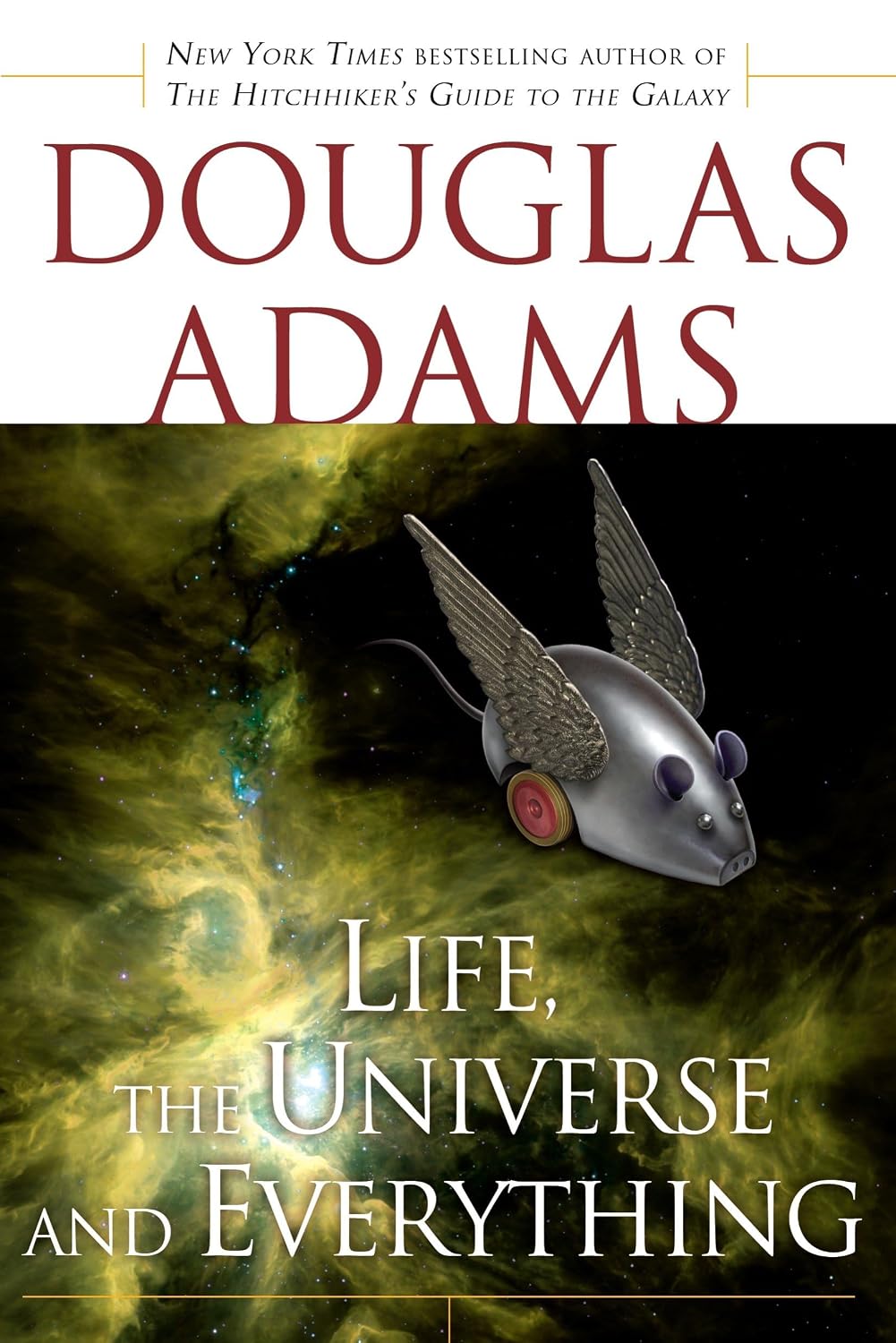
Cover of another edition
Life, the Universe and Everything
About this workSummary, languages, provenance, and download
What you will learnThe main threads to follow while reading
Follow the new plot without reducing the novel to the answer 42; notice how digressions alter the meaning of events.
In a few words (short summary)The book’s argument, structure, and limits
The third novel sends Arthur Dent back into a cosmic adventure in which the answer 42 still fails to resolve the original problem.
The third book resumes Arthur Dent’s story after his time on prehistoric Earth and widens it to a new threat to the Galaxy. Adams keeps the Guide’s comic logic, placing decisive events alongside wildly incongruous details.
This entry covers the anthology’s third novel in chapter order, distinct from the books on either side of it.
Four-page AI synthesisA complete reading to browse without leaving the page
A way out of prehistory, a threat at Lord’s
Arthur Dent has spent five years on prehistoric Earth. His cave stands where Islington will one day be, but no bus is due for two million years. Ford Prefect left four years earlier. Arthur talks to trees to keep hold of language, fails at gardening and wakes each morning with the shock of remembering where he is. One visitor briefly raised his hopes of rescue: an alien landed, insulted him and flew away. The encounter shows how isolated Arthur has become, and how little the wider Universe appears to care about his predicament.
That visitor is Wowbagger, made immortal by accident. Having exhausted the pleasures of living indefinitely, he has assigned himself an endless job: insult every inhabitant of the Universe personally and in alphabetical order. His itinerary turns the large question of what gives an unending life purpose into a filing problem. Arthur, facing a smaller but acute version of purposelessness, decides one morning that going mad might help him bear his solitude. Ford returns just as he announces the decision. Their reunion brings relief, along with Ford’s familiar ability to irritate him almost immediately.
Ford has detected a disturbance in space-time. It appears as a Chesterfield sofa drifting across a field. The two men chase it, jump aboard and land in the middle of the pitch at Lord’s during the closing stages of an England–Australia cricket match. Arthur briefly enjoys tea, mown grass and the familiar details of his former life. Then Ford points to the date on a newspaper: Earth is due to be demolished in two days. Arthur’s return home gives him no lasting shelter, and even the ordinary objects he carries seem to have changed during the journey.
At the ground, Ford spots a ship that the crowd overlooks because it is covered by a Somebody Else’s Problem field. Slartibartfast emerges and demands the urn containing the Ashes, insisting that it matters to the Galaxy’s safety. White robots then attack Lord’s, mimicking cricket strokes while hitting explosive balls. Arthur and Ford escape with Slartibartfast in a ship shaped partly like a small Italian restaurant. A sporting relic, a wandering sofa and a galactic attack now belong to the same story. The characters have scarcely had time to ask how they connect.
Krikkit: from an empty sky to a galactic war
Slartibartfast’s ship runs on Bistromathics, calculations drawn from the unreliable numbers on restaurant bills: who ordered what, how many people ate and what each person is prepared to pay. The joke also powers travel through space and time. In a room of Informational Illusions, Arthur and Ford enter a presentation of the ancient Krikkit Wars. A lavish documentary introduces the Wikkit Gate, made of steel, wood and Perspex pillars supporting gold and silver bails. The grand music and salesmanship make the account hard to take at face value, even as its underlying events become urgent.
Krikkit lies inside a dust cloud that conceals every star from its inhabitants. They have never asked whether they are alone in the Universe because they do not know there is a Universe to be alone in. A crashed alien ship gives them the means to build a ship of their own, with a speed Ford finds impossible to credit. Its pilots cross the cloud and see the stars for the first time. Their response to this discovery is to decide that everything beyond Krikkit must go. The blank sky has shaped what they can imagine; seeing past it does not immediately enlarge their sympathies.
Their decision becomes a war fought by huge fleets and lethal white robots. Krikkit forces strike many worlds at once, seize resources for further construction and destroy the worlds they have raided. The account insists on an unsettling combination: the people can be pleasant in ordinary life while supporting the obliteration of every other life form. Their domestic songs and their military purpose occupy the same history. The destruction is too large to be treated as a harmless misunderstanding, yet the speed with which an enclosed world acquires vast technology and a single murderous purpose remains conspicuously strange.
After the Galaxy wins, Judge Pag orders Krikkit and its sun sealed inside an envelope of Slo-Time. They are to emerge only after the rest of the Universe has ended, receiving the solitude they sought. A lock on an orbiting asteroid controls the enclosure, and the Wikkit Gate serves as its key. A surviving Krikkit warship tries to seize that key. Ship and key are scattered through space-time rather than lost forever. Slartibartfast traces several of the pieces as they reappear. The white robots are collecting them, and the historical account has become an immediate race to keep the planet locked.
The scattered key and the people caught in its path
The search for the key sends the story across several places and lives. On a marsh world, the Krikkit robots take an artificial leg from Marvin, who has spent more than a million and a half years walking in a tiny circle. Aboard the Heart of Gold, they seize the gold bail embedded in its Improbability Drive. Zaphod Beeblebrox confronts them and is shot. Parts of an ancient symbol have resurfaced as a prosthesis, a ship component and other objects with quite different uses. That disguise makes the pieces difficult to identify and the lock difficult to defend.
Slartibartfast traces the silver bail to a party that has lasted four generations. Its flying building raids the planet below for supplies and has helped ruin the land. Trillian is there after teleporting away from Zaphod without setting a destination. Arthur encounters her among the guests and meets Thor as well. The robots arrive before Slartibartfast’s group can secure the bail. They take the award containing it and badly damage the party. Arthur challenges Thor, then uses the moment when Thor steps outside to escape with the others. The pursuit of a small metal piece passes through a social event that has itself become a sustained form of destruction.
Arthur’s route to the party has already been interrupted by Agrajag, who lures him into a Cathedral of Hate. Agrajag says he has been reincarnated repeatedly as creatures that died through encounters with Arthur, including the rabbit whose skin became Arthur’s bag and a bowl of falling petunias. Arthur denies persecuting him intentionally. In trying to restrain Agrajag, he nevertheless causes his death again. Arthur flees an ensuing landslide and, distracted while falling, begins to fly as the Guide earlier described. Flight offers him a rare sense of delight, although trying to think too hard about how he does it makes him fall.
Trillian, meanwhile, studies another history in the Room of Informational Illusions. Hactar, a computer once ordered to build a weapon that could destroy the Universe, had put a flaw in the bomb to prevent its use. Its makers pulverized it. The supplied passages set this account beside the history of Krikkit without yet establishing the connection between them. They also show the damage done by time travel: objects return in unexpected places, a poet’s work acquires a disputed origin and a cathedral disappears from history altogether. Following the key means working with traces whose origins and routes through time cannot be taken for granted.
The lock opens, but the outcome is still out of view
The group reaches the lock’s asteroid too late to stop the robots inserting the assembled key. The asteroid passes through the dust cloud, the Slo-Time enclosure opens and the robots destroy the lock. The immediate means of sealing Krikkit again is gone. Ford and Trillian find Zaphod alive, though injured: the robots had carried him away and repeatedly knocked him unconscious. After the lock’s destruction, he once more has the gold bail. It and the wooden pillar survived intact. Slartibartfast’s attempt to keep the planet enclosed has failed, but opening the enclosure does not yet establish what every newly released Krikkiter will choose to do.
On Krikkit, the visitors find a divide between pastoral ground below and war zones suspended high in the sky. When inhabitants surround them, the encounter does not become the expected execution. These Krikkiters worry about universal destruction, the balance of nature and what would happen to their sport. One young man acknowledges that a small bomb might destroy everything, yet struggles to explain why they must use it. Trillian tells him he need not do so and asks to meet those leading the war zones. The conversation gives the planet’s inhabitants thoughts and doubts that the earlier account of their campaign could not contain.
The distinction grows sharper as Zaphod infiltrates a war command centre above the planet. He hears that commanders there are largely untouched by the uncertainty spreading among people on the ground. He also hears that the robots have become listless about the war. The final supplied excerpt begins to describe Marvin connected to the central core of the Krikkit War Computer, then breaks off in the middle of a sentence. The story has brought the bomb, the command structure, the robots and the possibility of refusal into the same place. These passages do not yet show how their confrontation ends.
The evidence supplied here stops before the novel’s ending. It supports the opening of Krikkit and the first visible resistance to its destructive purpose, but gives no basis for stating what happens to the bomb, what Marvin ultimately does or how the planet’s fate is settled. What is already clear is the pressure at the centre of the plot: a world first responds to discovering others by seeking to erase them, while some of its inhabitants begin to question the order they have inherited. Arthur, so often carried into events he barely understands, discovers that even a fall can change direction. The resolution remains beyond the supplied text.
Synthesis generated by GPT-5.6 from the normalized text of the work. It is a reading aid, not a substitute for reading or citing the text.
- Availability
- Text available
- Text quality
- Automatic checks passed
- Text format
- Digital text extracted from the document
- Document type
- Author’s text
- Usage rights
- Authorized for this project
- Excerpts
- 197
- Translation
- GPT-5.6 · non-official AI, reviewed
Life, the Universe and Everything section 1
HTML section 1, excerpt 1/6
Non-official AI translation
Chapitre 1
Le cri d'horreur qu'on entendait régulièrement au petit matin était celui d'Arthur Dent lorsqu'il se réveillait et se rappelait soudain où il se trouvait.
Ce n'était pas seulement que la grotte était froide, ni seulement qu'elle était humide et malodorante. C'était que la grotte se trouvait au beau milieu d'Islington et qu'aucun bus ne passerait avant deux millions d'années.
Le temps est le pire endroit où se perdre, pour ainsi dire, comme pouvait en témoigner Arthur Dent, qui s'était souvent perdu aussi bien dans le temps que dans l'espace. Au moins, quand on se perdait dans l'espace, on avait de quoi s'occuper.
Il était coincé sur la Terre préhistorique à la suite d'un enchaînement complexe d'événements qui l'avaient vu tour à tour exploser et se faire insulter dans des régions de la Galaxie plus étranges qu'il n'aurait jamais imaginé qu'il en existât. Et même si sa vie était à présent devenue très, très, très calme, il sursautait encore au moindre bruit.
Cela faisait maintenant cinq ans qu'il n'avait pas explosé.
Comme il n'avait presque vu personne depuis que Ford Prefect et lui s'étaient séparés quatre ans plus tôt, il ne s'était pas non plus fait insulter pendant tout ce temps.
Sauf une fois.
C'était arrivé un soir de printemps, environ deux ans auparavant.
Il regagnait sa grotte peu après le crépuscule lorsqu'il aperçut des lumières qui clignotaient étrangement à travers les nuages. Il se retourna et fixa le ciel, tandis que l'espoir lui remontait soudain au cœur. Des secours. Une évasion. Le rêve impossible du naufragé : un vaisseau.
Sous ses yeux ébahis et pleins d'excitation, un long vaisseau argenté descendit dans l'air tiède du soir, tranquillement, sans cérémonie, tandis que ses longues pattes se déployaient en un ballet technologique d'une parfaite fluidité.
Il se posa doucement sur le sol, et le faible bourdonnement qu'il avait produit s'éteignit, comme bercé par le calme du soir.
Une rampe se déploya.
La lumière se répandit au-dehors.
HTML section 1, excerpt 2/6
Non-official AI translation
Une grande silhouette apparut, découpée à contre-jour dans l'écoutille. Elle descendit la rampe et s'arrêta devant Arthur.
« Tu es un crétin, Dent », dit-elle simplement.
C'était un extraterrestre, très extraterrestre. Il avait une grande taille étrangement extraterrestre, une tête aplatie étrangement extraterrestre, de petits yeux extraterrestres réduits à des fentes, d'extravagantes cordes dorées drapées sur lui, avec un col d'un dessin particulièrement extraterrestre, et une peau extraterrestre gris-vert pâle dont l'éclat satiné était de ceux que la plupart des visages gris-vert ne peuvent acquérir qu'à force d'exercice et de savon très coûteux.
Arthur le contempla, ahuri.
L'autre soutint son regard sans ciller.
Les premiers élans d'espoir et d'appréhension d'Arthur avaient aussitôt été submergés par la stupéfaction, et toutes sortes de pensées se disputaient à cet instant l'usage de ses cordes vocales.
« Qu... ? » dit-il.
« Ma... euh... ah... » ajouta-t-il.
« Re... ra... ouah... qui ? » parvint-il enfin à dire avant de sombrer dans une sorte de silence frénétique. Il ressentait les effets d'une période sans conversation plus longue que ses souvenirs ne lui permettaient de mesurer.
La créature extraterrestre fronça brièvement les sourcils et consulta ce qui semblait être une sorte de porte-bloc, qu'elle tenait dans sa main extraterrestre, fine et décharnée.
« Arthur Dent ? » demanda-t-elle.
Arthur hocha la tête, impuissant.
« ArthurPhilip Dent ? » poursuivit l'extraterrestre d'une voix aboyante et efficace.
« Euh... euh... oui... euh... euh », confirma Arthur.
« Tu es un crétin, répéta l'extraterrestre, un parfait connard. »
« Euh... »
La créature hocha la tête pour elle-même, traça une étrange coche extraterrestre sur son porte-bloc et se retourna vivement vers le vaisseau.
« Euh... », dit Arthur, désespéré, « euh... »
« Ne me sors pas ça ! » lança sèchement l'extraterrestre. Il remonta la rampe, franchit l'écoutille et disparut à l'intérieur du vaisseau. Celui-ci se referma hermétiquement. Un sourd bourdonnement pulsé se fit entendre.
« Euh, hé ! » cria Arthur, qui se mit à courir vers lui sans trop savoir quoi faire.
HTML section 1, excerpt 3/6
Non-official AI translation
« Attendez une minute ! » cria-t-il. « Qu'est-ce que c'est que ça ? Quoi ? Attendez une minute ! »
Le vaisseau s'éleva, comme s'il laissait tomber son poids à terre tel un manteau, et resta un instant en suspension. Il fila d'une étrange façon dans le ciel du soir. Il traversa les nuages, les illumina brièvement, puis disparut, laissant Arthur seul au milieu d'une terre immense, agité d'une petite danse dérisoire.
« Quoi ? » hurla-t-il. « Quoi ? Quoi ? Hé, quoi ? Revenez me dire ça en face ! »
Il sauta et dansa jusqu'à ce que ses jambes tremblent, et cria jusqu'à s'en écorcher les poumons. Personne ne répondit. Il n'y avait personne pour l'entendre ni pour lui parler.
Le vaisseau extraterrestre fonçait déjà vers les hautes couches de l'atmosphère, en route pour le vide effroyable qui sépare les très rares choses qui existent dans l'Univers les unes des autres.
Son occupant, l'extraterrestre au teint coûteux, s'adossa à son unique siège. Il s'appelait Wowbagger l'Infiniment Prolongé. C'était un homme qui avait un but. Un but pas très louable, comme il aurait été le premier à l'admettre, mais c'était tout de même un but, et il avait au moins le mérite de le garder en mouvement.
Wowbagger l'Infiniment Prolongé était, et est d'ailleurs toujours, l'un des très rares êtres immortels de l'Univers.
Ceux qui naissent immortels savent d'instinct comment s'en accommoder, mais Wowbagger n'était pas de ceux-là. À vrai dire, il avait fini par les détester, cette bande d'enfoirés placides. Son immortalité lui était tombée dessus à la suite d'un malencontreux accident mettant en jeu un accélérateur de particules irrationnel, un déjeuner liquide et une paire d'élastiques. Les détails précis de l'accident n'ont pas d'importance, car personne n'a jamais réussi à reproduire les circonstances exactes dans lesquelles il s'est produit, et beaucoup de gens qui ont essayé ont fini par avoir l'air parfaitement ridicules, ou par mourir, ou les deux.
HTML section 1, excerpt 4/6
Non-official AI translation
Wowbagger ferma les yeux, le visage sombre et las, mit un peu de jazz léger sur la chaîne du vaisseau et songea qu'il aurait pu tenir, sans les dimanches après-midi. Il aurait vraiment pu.
Au début, c'était amusant. Il s'en donnait à cœur joie : il vivait dangereusement, prenait des risques, empochait de gros bénéfices grâce à des placements à long terme et à haut rendement, et, d'une manière générale, survivait à tout le monde avec une belle insolence.
Au bout du compte, ce furent les dimanches après-midi qu'il ne put supporter, avec cette terrible apathie qui commence à s'installer vers 14 h 55, quand on sait qu'on a déjà pris tous les bains qu'il était utile de prendre ce jour-là, qu'on aura beau fixer n'importe quel paragraphe du journal, on ne le lira jamais vraiment et on n'essaiera jamais la nouvelle technique révolutionnaire de taille des arbres qu'il décrit, et que, sous nos yeux rivés à l'horloge, les aiguilles avanceront inexorablement jusqu'à quatre heures, où commencera la longue et sombre heure du thé de l'âme.
Les choses commencèrent donc à perdre leur attrait. Les sourires enjoués qu'il arborait autrefois aux enterrements des autres s'estompèrent. Il se mit à mépriser l'Univers en général, et chacun de ses habitants en particulier.
C'est alors qu'il conçut son but, ce qui le pousserait à continuer et qui, pour autant qu'il pût en juger, le pousserait à continuer éternellement. Le voici.
Il allait insulter l'Univers.
C'est-à-dire qu'il allait insulter tous ceux qui s'y trouvaient. Individuellement, personnellement, un par un et, c'était sur ce point qu'il avait vraiment décidé de serrer les dents, par ordre alphabétique.
Quand on lui objectait, comme cela était arrivé, que son projet était non seulement malavisé mais carrément impossible, compte tenu du nombre de gens qui naissaient et mouraient à chaque instant, il se contentait de fixer son interlocuteur d'un regard d'acier et de répondre : « On a bien le droit de rêver, non ? »
HTML section 1, excerpt 5/6
Non-official AI translation
Il se mit donc à l'ouvrage. Il équipa un vaisseau spatial conçu pour durer d'un ordinateur capable d'effectuer tout le traitement de données nécessaire pour suivre l'ensemble de la population de l'Univers connu et calculer les itinéraires d'une effroyable complexité que cela impliquait.
Son vaisseau traversait à toute allure les orbites intérieures du système solaire, prêt à contourner le Soleil pour profiter de son effet de fronde et se lancer dans l'espace interstellaire.
« Ordinateur », dit-il.
« Présent », jappa l'ordinateur.
« Où allons-nous ensuite ? »
« Je calcule. »
Wowbagger contempla un instant les joyaux fantastiques de la nuit, les milliards de minuscules mondes de diamant qui parsemaient de lumière les ténèbres infinies. Chacun d'eux, absolument chacun, figurait sur son itinéraire. Il devrait se rendre sur la plupart des millions de fois.
Il imagina un instant son itinéraire reliant tous les points lumineux du ciel comme dans un dessin à points numérotés pour enfants. Il espérait que, vu d'un certain endroit de l'Univers, il composerait un mot très, très grossier.
L'ordinateur émit un bip sans mélodie pour signaler qu'il avait terminé ses calculs.
« Folfanga », dit-il. Il émit un bip.
« Quatrième monde du système de Folfanga », poursuivit-il. Il émit de nouveau un bip.
« Durée estimée du voyage : trois semaines », poursuivit-il encore. Il émit de nouveau un bip.
« Pour y rencontrer une petite limace », bip, « du genre A-Rth-Urp-Hil-Ipdenu. »
« Je crois, ajouta-t-il après une courte pause ponctuée d'un bip, que vous aviez décidé de la traiter d'abruti sans cervelle. »
Wowbagger grogna. Il contempla pendant un moment la majesté de la création derrière son hublot.
« Je crois que je vais faire une sieste, dit-il, puis il ajouta : quelles zones de réseau allons-nous traverser dans les prochaines heures ? »
L'ordinateur émit un bip.
« Cosmovid, Thinkpix et Home Brain Box », dit-il, puis il émit un bip.
HTML section 1, excerpt 6/6
Non-official AI translation
« Des films que je n'ai pas déjà vus trente mille fois ? »
« Non. »
« Ah. »
« Il y a Angoisse dans l'espace. Vous ne l'avez vu que trente-trois mille cinq cent dix-sept fois. »
« Réveille-moi pour la deuxième bobine. »
L'ordinateur émit un bip.
« Dormez bien », dit-il.
Le vaisseau poursuivit sa course dans la nuit.
Pendant ce temps, sur Terre, une pluie battante se mit à tomber. Arthur Dent resta dans sa grotte et passa l'une des soirées les plus franchement pourries de toute sa vie à chercher ce qu'il aurait pu dire à l'extraterrestre et à taper sur les mouches, qui passèrent elles aussi une soirée pourrie.
Le lendemain, il se fabriqua une bourse en peau de lapin, parce qu'il pensait qu'elle serait pratique pour y ranger des choses.