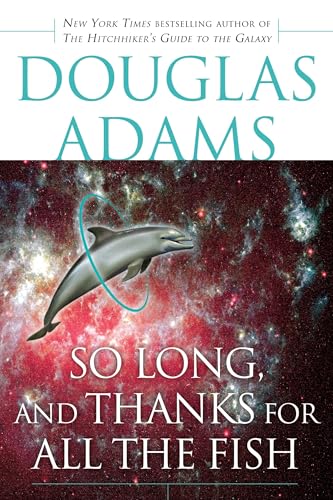
Cover of another edition
So Long, and Thanks for All the Fish
About this workSummary, languages, provenance, and download
What you will learnThe main threads to follow while reading
Trace what the novel does with the need for explanation, distinguish the love story from its science-fiction machinery, and place this fourth adventure in the series without conflating this novel with the other texts in the anthology.
In a few words (short summary)The book’s argument, structure, and limits
Arthur Dent returns to an Earth that should have been destroyed and meets Fenchurch, the only other person who senses that something decisive has been forgotten. Douglas Adams turns their inquiry and the dolphins’ disappearance into a comedy about happiness, memory, and explanations that fit too neatly.
The fourth Hitchhiker’s Guide novel returns Arthur to English suburbs, pubs, and rain after his travels through space. Meeting Fenchurch gives the story a love plot, while the fish bowls left by the dolphins lead toward a final message for humanity. Its absurdity comes from placing metaphysical questions beside bureaucratic and domestic detail.
The text comes from the fourth novel in the HTML anthology. This record follows that specific book, separate from the other volumes and the short story in the same file.
Four-page AI synthesisA complete reading to browse without leaving the page
An Impossible Earth and Two Broken Memories
The novel returns to Earth’s durable problem of ordinary unhappiness. Money, technology, and public schemes have failed to correct a species that remains anxious, unkind, and dissatisfied. Then, one Thursday, a young woman sitting in a Rickmansworth cafe suddenly understands how the world could become good and happy. Her discovery seems simple, correct, and immediately workable. Before she can communicate it, a catastrophe erases the idea. This opening establishes the governing question: what survives of a truth when the experience that produced it remains only as a fracture in memory? The story therefore begins not with a cosmological explanation but with a lost intuition, at once private and universal.
Arthur Dent then returns to an Earth that contradicts everything he knows. A spacecraft deposits him, his shopping bag, and his towel in a rain-lashed English night. By his own reckoning he saw the Vogons destroy this planet eight years earlier, yet he recognizes roads, cars, villages, and signposts. Normality becomes more disturbing than outer space. Rob McKenna, a driver who has catalogued 231 varieties of rain, appears to be merely a permanently embittered haulier. The narrator reveals that the clouds love and follow him: McKenna is a Rain God who does not know his nature. This first terrestrial wonder sets an important comic rule. An impossible fact may hide inside a life for which the everyday explanation seems perfectly adequate.
Russell gives Arthur a lift, and Arthur notices Russell’s unconscious sister in the back seat. Called Fenny by her brother, she has been drugged after another crisis. Russell irritably describes her delusions, nightmares, and strange brainwave jumps. One detail shocks Arthur: her original collapse occurred in a Rickmansworth cafe at the very time when Earth should have been destroyed. He can now suspect that she is the woman from the opening without knowing what she discovered or lost. Back in his village, he finds the pub, familiar acquaintances, and even a dog he remembers. Nobody, however, can corroborate his travels, while his aged and weathered appearance makes him a stranger at home. The visible planet denies his memory, but Fenchurch’s illness seems to preserve a scar left by the same event.
His house also survives, buried behind eight years of mail. In the bedroom he finds an anonymous gift: an exquisite silver-grey glass fish bowl engraved with the opening words of a farewell and a thank-you. Arthur puts his Babel fish in it, but understands chiefly that someone is trying to tell him something. Elsewhere, Ford Prefect discovers that the Guide’s entry on Earth, formerly compressed into “Mostly harmless,” has been extensively revised. Since he personally witnessed the planet’s destruction, the update persuades him that something exceptionally strange is happening. Arthur and Ford thus approach the same mystery from opposite directions. One has recovered a material home he can no longer trust; the other has watched a galactic information system acknowledge the return of the impossible.
Fenchurch, Love, and the Missing Revelation
Two months after his return, Arthur has slipped back into his old life with almost insulting ease. His galactic years are receding, although his delight in earthly existence persists. He meets Fenchurch again at a motorway service station and offers her a lift. Their courtship advances through embarrassment, delay, and interruption. Arthur already knows the nickname she hates; a raffle seller repeatedly breaks into his attempted confession; the few miles remaining before her train threaten to end the conversation. She gives him her real name, bestowed because she was conceived in the ticket queue at Fenchurch Street station. The comedy does not cancel their attraction. It gives that attraction a material shape made of nervous talk, quick wit, and opportunities that are very nearly missed.
Arthur then loses her telephone number with the raffle ticket but refuses to let the meeting disappear. Using vague prehistoric memories of the night sky, astronomical software, rough diagrams, and layers of guesswork, he calculates an address. The method is preposterous and, through unfathomable chance, exactly right. At Fenchurch’s converted stable, intimacy grows together with narrative trust. Arthur tells her about the railway-station biscuits: believing that a stranger is calmly eating from his packet, he retaliates with rigid English hostility, only to find his own biscuits beneath his newspaper. The incident offers a miniature of the entire novel. A coherent interpretation can be utterly mistaken because one crucial object has been placed just outside the observer’s frame.
Fenchurch answers with a childhood memory. She used to worry about an otter that seemed to be pulling a crowded raft, until she noticed the raft’s sail and the imagined burden vanished. That sudden correction of perspective resembles her Rickmansworth revelation, but the later experience was incomparably stronger. For days she had felt as though the whole Earth were gathering itself through her. An astonishingly simple solution arrived, followed by the sensation that the planet had exploded. She woke in hospital unable to recover the idea. The number forty-two means nothing to her. Her lost knowledge is therefore not a convenient repetition of the series’ earlier answer, but an absence whose emotional certainty survives after its content has gone.
Arthur finally tells her about Earth’s destruction and his travels. Fenchurch reveals that all the dolphins vanished at the same time, and she still has the Guide he dropped in Russell’s car. Their stories lock together. Arthur lost his world and recovered it in an inexplicable form; Fenchurch found a truth and then lost it. Another anomaly brings them physically closer. Her feet do not quite touch the ground. Arthur recognizes an ability related to his own knack for flight, which involves falling while failing to hit the Earth, and teaches her to yield to the impossible. They soar above London, begin to plummet when ordinary physical expectations reclaim them, catch each other, and rise again. Flight embodies their happiness but settles nothing. Fenchurch insists that recovered love cannot stand in for the missing message.
The Dolphins, the Asylum, and the Way Off Earth
The vanished dolphins provide the only usable lead. Newspapers have dropped the subject because a continuing absence generates no new event, but Arthur traces John Watson to California. Watson calls himself Wonko the Sane and has built his house inside out: the surrounding world is symbolically enclosed in an “Asylum,” while he lives outside it. He reached this decision after reading instructions on a packet of toothpicks so elaborate that they seemed to prove civilization’s madness. His conclusion is ridiculous yet awkwardly persuasive, especially in a story where institutions preserve authority by renaming what they cannot explain. Scientists reject “Rain God” in favor of an opaque meteorological label that sounds more professional while adding no understanding.
Wonko studied and swam with dolphins, and he owns a silver-grey bowl identical to Arthur’s. He identifies it as a farewell gift from them. After removing the wheatgerm his wife had stored in it, he cleaned the bowl and held it to his ear. Arthur and Fenchurch realize that the bowls must be heard rather than treated as handsome household containers. This material clue confirms that the dolphins’ departure, Fenchurch’s sense of catastrophe, and Earth’s impossible presence belong to one story. It does not restore her lost social revelation. Instead, it directs them toward another utterance, God’s Final Message to His Creation, located far beyond Earth. Fenchurch chooses to follow the clue despite its uncertainty, preferring a hazardous inquiry to a diagnosis that would dismiss the reality of what she experienced.
Ford has meanwhile followed his own erratic route home. Once the Guide confirms Earth’s renewed existence, he commandeers a ship and punishes its owner by leaving him in suspended animation around a moon while the London Speaking Clock broadcasts continuously at his expense. Cosmic revenge becomes an extravagantly engineered telephone bill. Back with Arthur, Ford encounters Fenchurch and another earthly marvel: a gigantic robot from a democracy where people elect the lizards they hate because they fear that otherwise the wrong lizard might win. After political negotiations collapse, the robot chooses to holiday in Bournemouth and later prepares to depart. What first appears to be an unrelated satire supplies exactly the transport Arthur and Fenchurch require.
The couple cannot reach the departing craft through the crowd, soldiers, and rising ramp. Ford arrives at the last moment in a taxi, wearing a white coat and carrying a megaphone. He proclaims a major scientific breakthrough, designates ordinary boxes as vital equipment, and turns the public’s respect for confident language into a boarding pass. When the police announce a break-in, he drowns them out, then scatters personal stereos into the crowd to create a diversion. The three push a supermarket trolley onto the ramp and are carried inside. The escape condenses the novel’s social comedy: institutions and crowds respond less to facts than to vocabulary, costume, and volume. Arthur is not leaving Earth to resume aimless wandering. He goes because Fenchurch’s loss has given the journey a precise, shared purpose.
The Final Message and a Modest Consolation
The journey takes Arthur and Fenchurch to the Great Red Plain of Rars, where the divine message burns across the Quentulus Quazgar Mountains. The approach has become a pilgrimage complete with booths, drinks, commemorative hats, and souvenir photographs. Scooters are initially denied to those who are not devout, so the couple continues on foot beneath the punishing sun. They overtake a metal wreck crawling painfully through the dust: Marvin, the depressive robot Arthur once knew, is now thirty-seven times older than the Universe because repeated errands have thrown him through time. Almost every component has been replaced at least fifty times. The diodes down his left side, whose pain he complained about when Arthur first met him, are the exception.
Arthur and Fenchurch carry Marvin to the viewing point. The letters shine so fiercely that looking through the pay telescope could damage a healthy eye, but Marvin can no longer raise his head and his visual circuits are failing. They help him inspect the inscription one letter at a time. God’s Final Message reads, “We apologise for the inconvenience.” Fenchurch immediately recognizes it as what she had lost. The revelation that was meant to heal the world is not a system, commandment, or proof. It is a cosmic apology, ludicrously slight beside the scale of suffering yet exactly fitted to her need for recognition. Marvin says that he thinks he feels good about it. The lights in his eyes then go out for the last time, ending his immense misery with the only consolation he has ever accepted.
The ending does not rearrange every mystery into a tidy mechanism. Earth’s existence remains paradoxical within Arthur’s experience, and the book repeatedly prefers a change of perspective to a total explanation. The misplaced biscuits, the unnoticed sail, Rob McKenna’s devoted clouds, Fenchurch’s hovering feet, and the bowls used for fish or wheatgerm all make the same point: an anomaly can be plainly visible without becoming intelligible. Conversely, scientific jargon, journalism, and the toothpick instructions make simple things needlessly elaborate. The novel does not reject reason. It distrusts the confidence with which a partial interpretation claims to be the whole world, then protects its mistake through habit, professional language, or procedure.
The love story offers a more workable answer. Arthur and Fenchurch do not cure humanity’s unhappiness, but they believe each other, exchange incompatible accounts of reality, and pursue a fragile clue together. Their happiness rests less on a formula than on mutual recognition. The epilogue nevertheless refuses a solemn final cadence. A distracted genetic engineer, ordered to create superwarriors against approaching invaders, instead invents a fly capable of escaping through the open half of a half-open window and an off-switch for children. The invaders admire these breakthroughs, agree to trade and cultural exchanges, and abandon the war. The narrator then forgets the point of the story. This last detour confirms the book’s comic conclusion: solutions may arrive sideways, an answer can be right without being grand, and peace itself may depend on attending brilliantly to the wrong problem.
Synthesis generated by GPT-5.6 from the normalized text of the work. It is a reading aid, not a substitute for reading or citing the text.
- Availability
- Text available
- Text quality
- Automatic checks passed
- Text format
- Digital text extracted from the document
- Document type
- Author’s text
- Usage rights
- Authorized for this project
- Excerpts
- 162
- Translation
- GPT-5.6 · non-official AI, reviewed
So Long, and Thanks for All the Fish section 1
HTML section 1
Non-official AI translation
Très loin, dans les eaux reculées et inexplorées de l’extrémité démodée du bras spiral occidental de la Galaxie, se trouve un petit soleil jaune auquel personne ne prête attention.
Autour de lui, à quelque quatre-vingt-douze millions de miles, gravite une petite planète bleu-vert tout à fait insignifiante. Les formes de vie qui y descendent du singe sont si étonnamment primitives qu’elles trouvent encore les montres numériques plutôt chouettes.
Cette planète a, ou plutôt avait, un problème : la plupart de ses habitants étaient malheureux presque tout le temps. On proposa bien des solutions, mais la plupart concernaient surtout les déplacements de petits morceaux de papier vert, ce qui est étrange puisque, dans l’ensemble, ce n’étaient pas les petits morceaux de papier vert qui étaient malheureux.
Le problème demeura donc entier ; beaucoup de gens étaient méchants et la plupart étaient misérables, même ceux qui possédaient une montre numérique.
Ils étaient de plus en plus nombreux à penser que descendre des arbres avait été, dès le départ, une grave erreur. Certains disaient même que les arbres avaient été une mauvaise idée et que personne n’aurait jamais dû quitter les océans.
Puis, un jeudi, près de deux mille ans après qu’on eut cloué un homme à un arbre pour avoir dit combien il serait formidable, pour changer, d’être gentil avec les autres, une jeune fille assise seule dans un petit café de Rickmansworth comprit soudain ce qui n’avait pas marché pendant tout ce temps. Elle sut enfin comment faire du monde un endroit bon et heureux. Cette fois, c’était la bonne solution, elle fonctionnerait, et personne n’aurait besoin d’être cloué à quoi que ce soit.
Hélas, avant qu’elle ait pu atteindre un téléphone pour en parler à qui que ce soit, une catastrophe d’une stupidité effroyable se produisit, et l’idée fut perdue à jamais.
Voici son histoire.