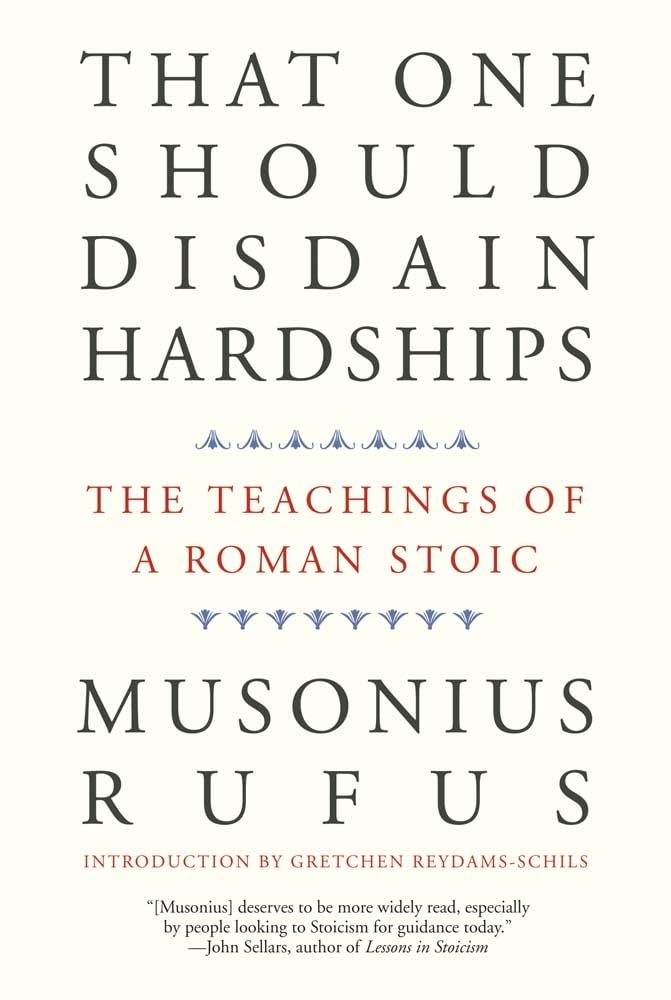
Cover of another edition
That One Should Disdain Hardships
About this workSummary, languages, provenance, and download
What you will learnThe main threads to follow while reading
Identify the argument that toil is not an evil, examine how it is applied to exile and material needs, and distinguish endurance as a moral means from the claim that suffering is good in itself.
In a few words (short summary)The book’s argument, structure, and limits
In Cora E. Lutz’s English translation, teachings attributed to Musonius Rufus present hardship as moral training rather than an evil in itself. Toil, exile, plain food, and measured exposure to cold raise one question: what must a person endure in order to live virtuously?
In the discourse that gives the book its title, Musonius argues that toil is not an evil and that people pursuing better ends should accept the effort those ends require. Endurance is therefore tied to a precise aim: becoming good and living happily.
Other texts in the volume apply this demand to exile, work, food, clothing, and shelter. They recommend reducing dependence on luxury and comfort without claiming that every kind of suffering is good in itself. The manifestation collects discourses and fragments attributed to Musonius in an English translation by Cora E. Lutz, with an introduction by Gretchen Reydams-Schils.
Four-page AI synthesisA complete reading to browse without leaving the page
Turning Moral Capacity into Conduct
This volume is not a continuous treatise written by Musonius Rufus. It assembles discourses, sometimes abridged, reportedly recorded by a certain Lucius, followed by fragments and sayings preserved in other authors, especially Epictetus. Cora E. Lutz’s English translation is reissued here with minor changes to spelling and punctuation and introduced by Gretchen Reydams-Schils. That mediated form matters. What survives is less a fully articulated system than philosophy caught in teaching, exhortation, replies to objections, and recollections of exemplary behavior.
Its starting point is nonetheless firm. Virtue is the only genuine good and vice the only genuine evil. Life, health, wealth, and pleasure are therefore not goods in the same sense, just as death, poverty, pain, and toil are not evils in themselves. Some external conditions may ordinarily be preferable to their opposites, but they cannot outrank just action. If friends or the community require defense, physical preservation and comfort may properly yield to courage, justice, and self-command.
The opening discourse displays Musonius’s method. Proof should lead from an accepted proposition to a conclusion that is not yet evident. If every evil is to be avoided, while many forms of toil should not be avoided, toil cannot be evil as such. A teacher gains nothing by piling up demonstrations when a few cogent ones can achieve the purpose. Instruction must nevertheless be adapted to the pupil. A person softened by luxury and bad habits will need more sustained treatment than someone already trained in restraint and ready to recognize the force of an argument.
Progress is possible because human beings possess a natural inclination toward virtue. People commonly claim to be intelligent, just, and temperate even when they cannot name anyone who taught them those qualities. Musonius takes this as evidence that the seeds of goodness are native to everyone, not that virtue matures without cultivation. Theory comes first because it identifies right action, but practice is more effective because it forms the capacity to act. Training must consequently address the soul through corrected judgments and the embodied person through measured exposure to cold, heat, hunger, thirst, scant food, hard beds, effort, and abstinence from pleasure. Such exercises are not punishment. They prepare courage and self-control for circumstances in which correct propositions alone would prove too weak.
The Same Virtue at Home, at Work, and in Public Life
The discourses develop this foundation by carrying it into ordinary situations. Their organizing principle is not a technical sequence of doctrines but a recurring test: what does philosophy become when it actually governs a life? Education, political rule, marriage, obedience to parents, and earning a livelihood are all measured by reason, justice, courage, and temperance. Ethics is not a separate subject reserved for lectures. It must determine how a person learns, works, commands, cooperates, and answers competing claims of authority.
Musonius argues that women possess reason, an inclination toward virtue, and the ability to acquire it just as men do. They should therefore study philosophy and receive the same education in everything that forms moral character. Against the objection that learning will make women presumptuous or negligent at home, he claims that genuine philosophy produces restraint, justice, courage, and willingness to work. His reasoning rejects a sexual double standard, particularly in demands for self-control. Yet it also retains ancient divisions of labor based on physical strength and often describes female virtue through the roles of wife, mother, and household manager. Tasks may cross those divisions when strength, need, or circumstance warrants it.
Marriage gives this shared moral capacity a social expression. Its end is not exhausted by procreation. It requires a community of body, soul, and possessions, together with mutual love and cooperation. Birth, money, and beauty cannot secure such a union; justice, self-control, and harmony of character can. Marriage is therefore no impediment to philosophy and may become one of its highest practical forms. Human sociability calls for care of intimate relationships as well as the common good, while the household, the city, and the continuation of the community depend upon the partnership of spouses and the raising of children.
The same standard reaches other forms of authority. A king particularly needs philosophy because he must distinguish benefit from harm, assign honor and punishment justly, and govern without becoming a servant of fear or false judgment. A child, by contrast, need not obey an unjust parental command. To fulfill a parent’s deepest intention is to do what is good, not to perform evil under the name of filial duty. For the philosopher’s livelihood, Musonius favors agriculture or shepherding. Work on the land provides dignified independence and makes teaching visible: master and pupils can discuss justice while laboring together. Endurance then ceases to be a classroom topic and becomes the shared structure of work, study, and daily observation.
Hardship as a Test of Judgment
The title discourse concentrates Musonius’s characteristic strategy. People ruled by erotic desire, profit, or fame willingly accept fatigue, danger, and humiliation for shabby rewards. Refusing all effort when the object is to discipline desire, assist friends, benefit the city, or become just is therefore incoherent. Toil is not pronounced good without qualification. Cleanthes explicitly declines to call it good in itself. Its significance depends on its purpose, although freedom from fear of toil brings a person closer to virtue by weakening the hold of material comfort.
Exile supplies the fullest case study. It removes a person from one city and certain associates, but not from earth, air, sunlight, all human society, or the power of judgment. Someone who understands the universe as a common city of gods and human beings does not identify an entire homeland with a birthplace. Exile may even provide leisure for study, release from political demands, and a simpler mode of life. Musonius does not claim that no material loss occurs. He denies that such loss reaches moral goodness. If the sentence was just, punishment is no ground for complaint; if it was unjust, the wrongdoing belongs to those who imposed it. He presents these arguments as reflections he used on himself, not merely advice delivered from a safe distance.
The same reversal governs his response to personal injury. Shame lies in committing injustice, not in suffering it. A philosopher should not automatically prosecute over an insult, assault, or mockery. The examples of Socrates and Phocion support patience and forgiveness, grounded in the view that many wrongs arise from ignorance and misunderstanding. The claim is intentionally stringent. To insist that a bad person cannot deprive a good person of moral good, then behave as though an injury had destroyed that good, would expose a contradiction between philosophical teaching and conduct.
Food, clothing, housing, and furnishings carry this work of judgment into repeated physical habits. Food should sustain health and strength rather than install the palate as master; plain and accessible nourishment is preferred to expensive refinement. Clothes and shoes protect the body instead of advertising status. A house gains no moral worth from costly materials transported over great distances, and furnishings should be judged by ease of acquisition, usefulness, and ease of preservation. Money released from display can benefit individuals or the city. Even hair is discussed in terms of function rather than ornament, although the treatment of the beard remains strongly marked by ancient ideals of masculinity. Across these cases, simplicity is not deprivation for its own sake. It is a practical reduction of vulnerability to appetite, fashion, expense, and loss.
What Endurance Means, and What It Does Not
The later material extends discipline across the whole span of life. The best provision for old age is the same as for youth: living according to nature through prudence, justice, courage, and temperance. Early training helps a person face bodily weakness, neglect by relatives, and especially fear of death; training begun late still matters if hearing leads to action. Wealth can purchase pleasures but cannot guarantee cheerfulness. Elsewhere Musonius condemns sexual excess, defends a marital and procreative norm, and imposes on men a self-command often demanded only of women. He also argues that every child born should be raised, connecting numerous children with mutual support, family continuity, and civic welfare.
The fragments compress these teachings into maxims, anecdotes, and pedagogical memories. They distinguish what is under our control, above all the use of impressions, from what must be yielded to the order of the universe, including body, country, and loved ones. They bind authority to example: a ruler who substitutes personal will for duty, or commands justice while acting wrongly, destroys the force of his own words. They value dying well over merely dying late, yet deny that someone useful to many may choose death unless dying would benefit more. Reason should remain in the soul like health-giving food, not arrive only as emergency medicine when emotion is already at its hottest.
These remnants also preserve the teacher’s manner. Musonius discourages prospective pupils to test whether their commitment has substance. He treats Epictetus’s failure in a logical exercise as the entire moral task immediately at hand, refusing the excuse that no spectacular crime has occurred. He likewise rejects philosophy as rhetorical entertainment. Loud applause suggests that verbal rhythm has displaced self-examination; useful speech should produce shame, repentance, attention, wonder, or silence. Yet such anecdotes cannot all be accepted as straightforward biography. The introduction treats them as evidence for Musonius’s philosophical image, while the recorded discourses represent only part of his teaching and often offer no more than compressed references to wider Stoic doctrine.
The collection’s strength lies in the repeated alignment of judgment, exercise, and conduct. Its limits arise both from the mediated sources and from ancient assumptions about gender roles, slavery, procreation, relations between men, and providential order. Those positions belong to the evidence and should neither be concealed nor mistaken for the core argument about hardship. That argument is narrower than a general praise of suffering. No privation produces virtue by itself. Endurance becomes morally valuable when it frees judgment from domination by fear and pleasure, supports just action, and reduces dependence on external goods that fortune, political power, illness, or age can always remove.
Synthesis generated by GPT-5.6 from the normalized text of the work. It is a reading aid, not a substitute for reading or citing the text.
- Availability
- Text available
- Text quality
- Automatic checks passed
- Text format
- Text recognized from the scan
- Document type
- Translation
- Usage rights
- Authorized for this project
- Excerpts
- 152
- Translation
- GPT-5.6 · non-official AI, reviewed
That One Should Disdain Hardships page 1
PDF page 1
Non-official AI translation
QU'IL FAUT
MÉPRISER LES ÉPREUVES
Y7601-Musonius.indb i 10/14/19 8:00:48 AM