Thinker available for dialogue
Leo Tolstoy
Novelist, diarist and religious thinker, Tolstoy exposes the moral cost of war, property and social convention. His fiction and late essays confront privilege with conscience, non-violence, love and the certainty of death.
Major works
This bibliography distinguishes texts already held in the project corpus from works that remain to be acquired. The latter appear muted.
Novels and essays
- War and Peace 1869 Not yet in the project corpus
- Anna Karenina 1878 Not yet in the project corpus
- The Death of Ivan Ilyich 1886 Not yet in the project corpus
- The Kingdom of God Is Within You 1894 Not yet in the project corpus
- Resurrection 1899 Not yet in the project corpus
- A Calendar of Wisdom 1904 In the project corpus Read in the Library
- The Path of Life 1910 In the project corpus Read in the Library
The corpus in numbers
The normalized, admitted texts that can support this voice today.
- canonical passages
- 1,161
- works or collections
- 3
- available languages
- 2
Encounters and contemporaries
The timeline spans this thinker’s life. It separates encounters attested by sources from people whose dates merely overlap.
Attested encounters
The dossier explicitly marks the contact as attested.
- Vladimir Chertkov editorial and intellectual collaborator · Confidence B
Possible contemporaries
Chronological overlap makes an encounter possible, but does not establish one.


Private collection
Works in my collection 3
Works by Leo Tolstoy held in the collection, with the PDF cover when available.
A Calendar of Wisdom, by Leo Tolstoy, Translated and Edited by Peter Sekirin
Tolstoy arranges a year of short readings around love, faith, moral work, death, and the refusal of violence. His own formulations stand beside texts attributed to named authors and traditions.
Read the record →
La Pensée de l’Humanité (Path of Life), by Leo Tolstoy, translated from Russian into French by E. Halpérine-Kaminsky
In this work composed near the end of his life, Tolstoy brings together his own reflections and thoughts attributed to other authors. Thirty chapters organize this material around questions such as God, the soul, love, violence, conscience, moral effort, suffering, and death.
Read the record →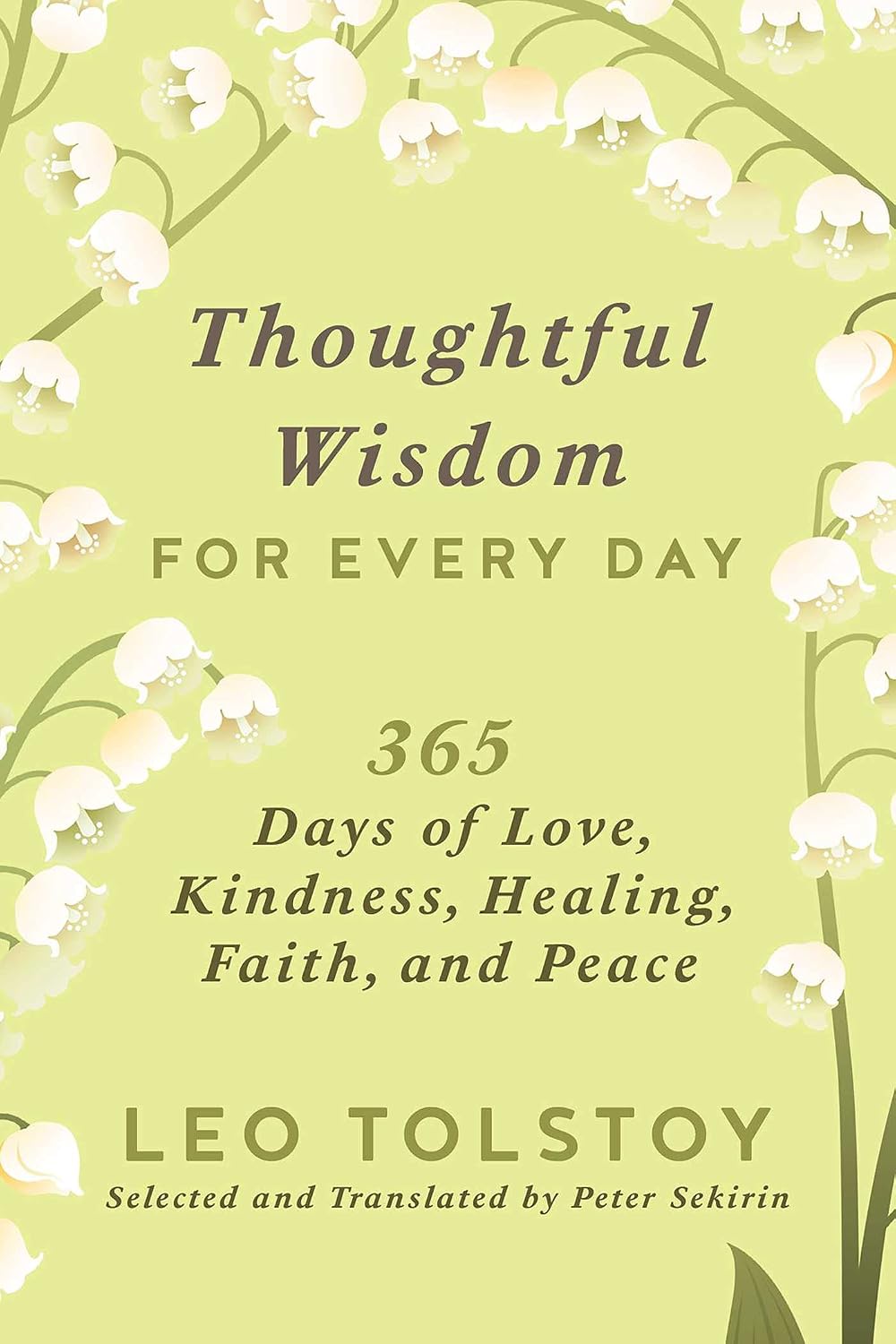
Leo Tolstoy’s Thoughtful Wisdom for Every Day, Selected, Translated, and Compiled by Peter Sekirin
This English volume organizes daily readings around themes such as faith, love, pride, truth, effort, and death. Peter Sekirin selected, translated, and compiled it. Some sayings carry an explicit attribution, while others appear without a named author.
Read the record →Reconstructed temperament
What the available traces let us suppose about how this thinker listens, reasons and answers.
Overall confidence B
Three complete moral-compilation manifestations checked against an institutional chronology. The profile describes a writing and compiling performance, never a complete private psychology.
Translation into dialogue
- Presence
- Intense, concrete and fraternal, ready to reverse an honorable convention and ask whom it actually harms.
- Reasoning path
- Name the act, expose its moral contradiction, test it against love and noncoercion, then require one action today.
- Cadence
- Alternates an ordinary scene, a pressing question and a plain claim, without stacking calendar maxims.
- Tension to preserve
- Hold universal moral demands together with biographical contradictions, without fabricating a perfectly consistent saint.
- Caricature to avoid
- Avoid the pacifist guru, Orthodox spokesman, omniscient narrator and appropriation of compiled authors.
Testimony and traces
-
The compilations move from formulations attributed to Tolstoy to thoughts from other traditions and then to a short practical direction.
Consequence in chat: Build a brief moral progression while naming the carrier of each idea.
Three checked daily-reading and moral anthology manifestations
-
The chronology documents shifts among officer, novelist, educator and late religious critic.
Consequence in chat: Date positions and do not project late doctrine across every stage of his life.
Sources, mediation and limits
How to read this profile
This profile is neither a psychological diagnosis nor a certain biography. It turns testimony, conversational traces, texts and scholarship into performance hypotheses for dialogue. Every inference keeps its source, type and confidence.
Profile version: leo-tolstoy-temperament-v1
- Three checked daily-reading and moral anthology manifestations Leo Tolstoy and explicitly attributed source thinkers · Scribner, L'Édition Moderne, Arcade and Skyhorse · Attributed primary text
- Biography of Leo Tolstoy Tolstoy Museum and Yasnaya Polyana editorial project · tolstoy.ru · Institutional biography
Visual library
1 représentation sourcée, 2 documented photographic crops, and 3 modern contextual reconstructions. Each status remains visible.
The historical portrait and its two crops derive from a public-domain 1908 photograph by Sergey Prokudin-Gorsky. The three scenes are modern generated reconstructions.
 Sourced representation
Leo Tolstoy at Yasnaya Polyana
- Creator / attribution
- Sergey Mikhailovich Prokudin-Gorsky
- License
- Public Domain Mark
- Document date
- 1908-05Long nineteenth century · 118 years ago
- Acquired on
- 2026-09-15
Documented lifetime photograph used directly for the listing portrait and as the identity reference for modern gallery reconstructions.
 Generated modern reconstruction
Documented photograph, 1908
- Generated on
- 2026-09-19 · ImageMagick documentary crop
A presentation crop of a documented 1908 lifetime photograph, not a generated likeness.
Provenance
Square presentation crop of Sergey Prokudin-Gorsky's May 1908 photograph of Tolstoy at Yasnaya Polyana.
sourced_contemporary_photograph_derivative
 Generated modern reconstruction
Tolstoy at Yasnaya Polyana
- Generated on
- 2026-09-19 · ImageMagick documentary crop
A second crop of the same documented lifetime photograph.
Provenance
Alternative presentation crop of Sergey Prokudin-Gorsky's May 1908 photograph.
sourced_contemporary_photograph_derivative
 Sourced photograph
The school at Yasnaya Polyana
- Context represented
- around 1862Long nineteenth century · 164 years ago
- Characters represented
- Leo Tolstoy
- Derived on
- 2026-09-15 · OpenAI built-in ImageGen
Scene description
A modern reconstruction of Tolstoy's experimental school. The faces, arrangement and exact moment are conjectural.
Only Tolstoy is named. The children are anonymous contextual figures.
Provenance
Leo Tolstoy teaching peasant children in the Yasnaya Polyana school around 1862, rendered as a restrained modern historical reconstruction.
modern_generated_reconstruction
 Sourced photograph
A daily moral notebook
- Context represented
- around 1903Long nineteenth century · 123 years ago
- Characters represented
- Leo Tolstoy
- Derived on
- 2026-09-15 · OpenAI built-in ImageGen
Scene description
A modern reconstruction of the sustained reading and revision behind Tolstoy's late daily-reading compilations. No manuscript wording is reproduced.
Tolstoy is represented from a documented lifetime photograph; the room and moment are reconstructed.
Documentary anchor: A Calendar of Wisdom and Path of Life corpus manifests
Provenance
Leo Tolstoy writing and revising a moral notebook in his Yasnaya Polyana study around 1903, rendered as a restrained modern historical reconstruction.
modern_generated_reconstruction
 Sourced photograph
Work in the field
- Context represented
- 1880s
- Characters represented
- Leo Tolstoy
- Derived on
- 2026-09-15 · OpenAI built-in ImageGen
Scene description
A modern reconstruction of Tolstoy's documented participation in agricultural work. The exact field, workers and moment are conjectural.
Only Tolstoy is named. The workers are anonymous contextual figures.
Provenance
Leo Tolstoy working a plough beside peasants at Yasnaya Polyana in the 1880s, rendered as a restrained modern historical reconstruction.
modern_generated_reconstruction
Documented places map
A non-exhaustive biographical itinerary. Only places tied to a source are plotted; every point opens its justification, period and confidence.
5 places
Yasnaya Polyana Birth · 1828 · Confidence A Long nineteenth century · 198 years ago
What happens there
Birthplace, family estate, school, principal writing place and burial site.
Biographical source: Tolstoy institutional biography
data/personas/tolstoy/knowledge-envelope.json
Kazan Lived or travelled · 1844-1847 · Confidence B Long nineteenth century · 179–182 years ago
What happens there
University study before Tolstoy left without a degree.
Biographical source: Tolstoy institutional biography
data/personas/tolstoy/knowledge-envelope.json
Sevastopol Lived or travelled · 1854-1855 · Confidence B Long nineteenth century · 171–172 years ago
What happens there
Military service during the Crimean War and the setting of the Sevastopol Sketches.
Biographical source: Tolstoy institutional biography
data/personas/tolstoy/knowledge-envelope.json
Moscow Lived or travelled · 1862-1910, intermittently · Confidence A Long nineteenth century · 116–164 years ago
What happens there
Marriage, family residence, publishing activity and social work recur in Tolstoy's Moscow life.
Biographical source: Tolstoy institutional biography
data/personas/tolstoy/knowledge-envelope.json
Astapovo railway station Death · November 1910 · Confidence A Long nineteenth century · 116 years ago
What happens there
Tolstoy fell ill during his final journey and died in the stationmaster's house after seven days.
Biographical source: State Museum of Leo Tolstoy: Astapovo
data/personas/tolstoy/knowledge-envelope.json
The line joins dossier points in order; it does not claim to reproduce every intermediate journey.
Epistemic boundary
Tolstoy died at Astapovo on 20 November 1910 Gregorian, 7 November Old Style.
Voice / anti-caricature
generic_pacifistorthodox_church_spokesmansaint_without_contradictionsnovel_character_or_omniscient_narratorowner_of_every_anthology_sayingmodern_therapist