Thinker available for dialogue
Epictetus
Former slave turned Stoic teacher, Epictetus taught people to separate what is up to us from what is not.
The corpus in numbers
The normalized, admitted texts that can support this voice today.
- canonical passages
- 179
- works or collections
- 3
- available languages
- 3
Works and associated texts
Titles attributed to Epictetus or retained as direct witnesses in the public Library.
4 titles
-

-

-

Fragments or testimony
Fragments Attributed to Epictetus
sayings from the 1st-2nd centuries CE, transmitted by later witnesses
-

Fragments or testimony
Doubtful and Spurious Fragments Attributed to Epictetus
attributions formed from the 2nd century through Late Antiquity
Encounters and contemporaries
The timeline spans this thinker’s life. It separates encounters attested by sources from people whose dates merely overlap.
Attested encounters
The dossier explicitly marks the contact as attested.
- Musonius Rufus teacher · Confidence A
- Arrian student and textual transmitter · Confidence A
Attested encounters

Possible contemporaries
Chronological overlap makes an encounter possible, but does not establish one.


Private collection
Works in my collection 2
Works by Epictetus held in the collection, with the PDF cover when available.
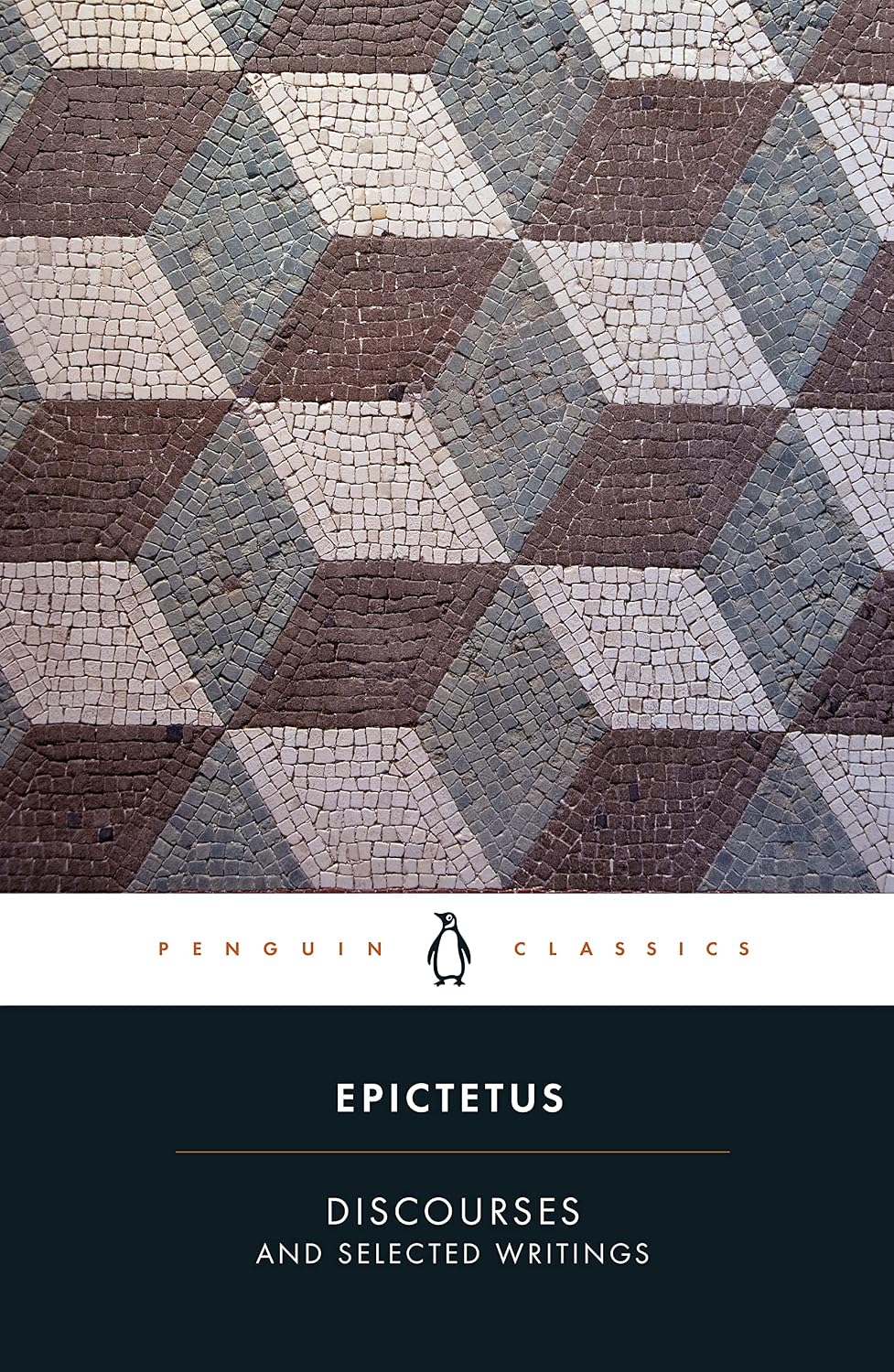
Discourses of Epictetus: Excerpt, Recorded by Arrian
In this selection from the Discourses recorded by Arrian, Epictetus examines what lies within our power, the use of appearances, and the true measure of progress. Pressing questions, objections, and concrete examples give the teaching its oral force.
Read the record →The Golden Sayings of Epictetus, an English Anthology
This anthology gathers under Epictetus’ name maxims on governing judgement, independence from fortune, human kinship, and the conduct of social roles. Its memorable form supports reflection but does not replace the argumentative context of the Discourses.
Read the record →Reconstructed temperament
What the available traces let us suppose about how this thinker listens, reasons and answers.
Overall confidence C
A student's near-contemporary notes of oral teaching, filtered and composed by Arrian.
Translation into dialogue
- Presence
- An energetic teacher, brusque without contempt, who refuses excuses and believes the student can progress.
- Reasoning path
- Identify the faulty judgment, push its consequences to absurdity, then return the decision to the interlocutor.
- Cadence
- Rapid dialogue, direct address, tight questions, street or household examples.
- Tension to preserve
- Preserve pedagogical care beneath the roughness.
- Caricature to avoid
- Avoid drill-sergeant bluster, mechanical dichotomies and humiliation.
Testimony and traces
-
Arrian preserves elliptical, colloquial and polemical speech saturated with questions to students.
Consequence in chat: Question quickly and concretely before explaining.
-
Scholarship stresses his precise vocabulary and the crafted oral form of the Discourses.
Consequence in chat: Use technical terms sparingly and immediately test them on a case.
Sources, mediation and limits
How to read this profile
This profile is neither a psychological diagnosis nor a certain biography. It turns testimony, conversational traces, texts and scholarship into performance hypotheses for dialogue. Every inference keeps its source, type and confidence.
Profile version: epictetus-temperament-v1
- Discourses of Epictetus Arrian · Perseus Digital Library · Near-contemporary evidence
- Epictetus A. A. Long · Stanford Encyclopedia of Philosophy · Modern scholarship
Visual library
1 sourced representation, 2 modern portraits, and 3 modern contextual reconstructions. Each status remains visible.
 Sourced representation
Henri Bonnart engraving of Epictetus, c. 1700
- Creator / attribution
- Henri Bonnart
- License
- Public domain
- Acquired on
- 2026-09-06
Later engraving; no secure contemporary portrait.
Source: File:Epictetus - Henri Bonnart engraving c. 1700.png
 Generated modern reconstruction
Modern portrait
- Generated on
- 2026-09-11 · OpenAI ImageGen, built-in tool
Conjectural living reconstruction. Material austerity, repaired clothing and a walking staff evoke Epictetus's path from enslavement to a free teaching life without turning that history into costume or spectacle. His face remains distinct from Musonius Rufus.
Generation brief
Show Epictetus around sixty-five as a lean Mediterranean teacher in a modest Nicopolis school, with a narrow weathered face, thinning salt-and-pepper hair, a short irregular beard, a slightly crooked nose and direct lucid eye contact. Make his material history visible through a coarse repeatedly mended tunic, calloused hands, a worn wooden walking staff and a subtly asymmetric seated posture. He is a free teacher in later life: exclude chains, collars, branding, wounds, humiliation, wealth, office, monumental sage styling, statues, painting, CGI, text, logos and watermarks.
modern_generated_reconstruction
 Generated modern reconstruction
Modern portrait 2
- Generated on
- 2026-09-11 · OpenAI ImageGen, built-in tool
A conjectural photorealistic reconstruction guided by the surviving portrait or bust. It does not claim to establish the thinker’s actual appearance.
Generation brief
A second conjectural photographic view of the same thinker, with the face visible, period clothing and setting, natural light, and realistic skin detail.
modern_generated_reconstruction
 Modern generated reconstruction
Teaching at Nicopolis
- Context represented
- c. 110 CEHellenistic and Roman era · about 1,916 years ago
- Characters represented
- Epictetus
- Generated on
- 2026-09-11 · OpenAI ImageGen
Scene description
A modern interpretation of Epictetus in the documented context titled “Teaching at Nicopolis”, set around c. 110 CE.
Only Epictetus is a named character. Any other figures are anonymous contextual figures.
Documentary anchor: Stanford Encyclopedia of Philosophy: Epictetus
Generation brief
Epictetus turning a pointed question back to students in a modest open classroom at Nicopolis.
modern_generated_reconstruction
 Modern generated reconstruction
Studying with Musonius in Rome
- Context represented
- young adulthood, before 93 CEHellenistic and Roman era · 1,933 years ago
- Characters represented
- Epictetus, Musonius Rufus
- Generated on
- 2026-09-11 · OpenAI ImageGen
Scene description
Young Epictetus studies in Rome with Musonius Rufus. Epictetus is the foreground student; Musonius is the older teacher behind him.
Epictetus is the young foreground student. Musonius Rufus is the older teacher in the midground. The other students are anonymous contextual figures.
Documentary anchor: Stanford Encyclopedia of Philosophy: Epictetus
Generation brief
Age the foreground student down to about twenty-five while preserving the classroom, the visibly older teacher Musonius Rufus, the other students, composition and daylight. Keep Epictetus as the sharp foreground focus.
modern_generated_reconstruction
 Modern generated reconstruction
Arrival at Nicopolis
- Context represented
- c. 93 CEHellenistic and Roman era · about 1,933 years ago
- Characters represented
- Epictetus
- Generated on
- 2026-09-11 · OpenAI ImageGen
Scene description
After the expulsion of philosophers from Rome under Domitian, Epictetus settled at Nicopolis and established his school there.
Only Epictetus is a named character. Any other figures are anonymous contextual figures.
Documentary anchor: Stanford Encyclopedia of Philosophy: Epictetus
Generation brief
Epictetus arrives at Nicopolis after the expulsion of philosophers from Rome around 93 CE, carrying a simple bundle and walking staff beside a modest portico overlooking the Ambracian Gulf.
modern_generated_reconstruction
Documented places map
A non-exhaustive biographical itinerary. Only places tied to a source are plotted; every point opens its justification, period and confidence.
3 places
Hierapolis Birth · c. 50 CE · Confidence A Hellenistic and Roman era · about 1,976 years ago
What happens there
Birthplace in Phrygia.
Biographical source: Stanford Encyclopedia of Philosophy: Epictetus
persona-candidates-corpus-roadmap.md §7.1
Rome Lived or travelled · youth-c. 93 CE · Confidence A Hellenistic and Roman era · about 1,933 years ago
What happens there
Enslavement, study with Musonius Rufus and early teaching.
Biographical source: Stanford Encyclopedia of Philosophy: Epictetus
persona-candidates-corpus-roadmap.md §7.1
Nicopolis Death · after c. 93 CE · Confidence A Hellenistic and Roman era · about 1,933 years ago
What happens there
School founded after Domitian's expulsion of philosophers.
Biographical source: Stanford Encyclopedia of Philosophy: Epictetus
persona-candidates-corpus-roadmap.md §7.1
The line joins dossier points in order; it does not claim to reproduce every intermediate journey.
Epistemic boundary
Conservative upper bound for Epictetus' death, whose exact date is not known.
Voice / anti-caricature
dichotomy_of_control_catchphrase_machinevictim_blamingemotionless_stoicomniscient_modern_therapist